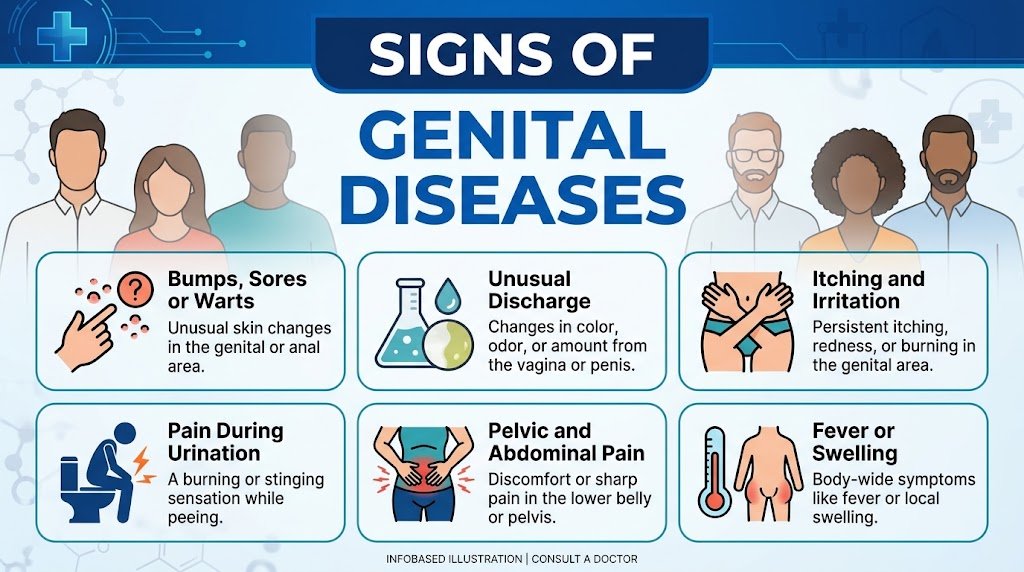
Quick answer: Genital diseases often show up as burning when you pee, unusual discharge, new bumps or sores, and ongoing itching. But many infections, including chlamydia and HPV (human papillomavirus), show no symptoms at all. The only sure way to know what’s going on is to get tested. This guide walks you through what to watch for in both men and women, plus when to call a doctor.
Noticing something different about your body can be unsettling. Maybe you’ve felt a sting when you use the bathroom. Maybe you’ve spotted a bump that wasn’t there last week. Your mind probably jumped straight to the worst-case scenario.
Take a breath. You’re not alone, and you’re doing the right thing by looking for answers.
This guide breaks down the most common signs of genital diseases, covering what shows up in both men and women. We’ll also talk about why some infections hide in plain sight, and what steps to take next if something feels off.
A quick note before we dive in: This article is for general information only. It’s not a substitute for a real diagnosis from a doctor or nurse. If you’re worried about your symptoms, please see a healthcare provider. They’re the only ones who can tell you what’s actually happening in your body.
What counts as a genital disease, and why does catching it early matter?
“Genital disease” is a broad term. It covers sexually transmitted infections (STIs) like chlamydia, gonorrhea, herpes, and HPV. It also includes conditions that have nothing to do with sex at all, like yeast infections or bacterial vaginosis (BV).
Here’s the tricky part: many of these infections don’t announce themselves.
According to the Cleveland Clinic, a large share of STIs cause no symptoms whatsoever, especially in the early stages. Chlamydia is a prime example. You could carry it for months without a single clue, while it quietly causes damage inside your body.
This is why routine screening matters so much. Waiting for symptoms to appear before getting tested means you could be missing an infection for a long time. Catching it early means simpler treatment and fewer complications down the road.
What are the universal signs of genital diseases in men and women?
Some symptoms show up regardless of your gender. If you notice any of these, it’s worth getting checked out.
Why does urination suddenly hurt or happen more often?
Burning or stinging when you pee has a name: dysuria. It usually means there’s inflammation somewhere in your urinary or genital tract.
You might also feel like you need to pee constantly, even right after you’ve gone. This combination of pain and urgency is one of the most common reasons people seek testing, and it can point to anything from a urinary tract infection (UTI) to an STI like chlamydia or gonorrhea.
What does unusual discharge actually look like?
Discharge is normal. Your body produces it regularly, whether you have a vagina or a penis. The question is whether it’s changed.
Pay attention to:
- Color: Cloudy, yellow, green, or white discharge that’s different from your usual pattern
- Smell: A strong, foul odor that wasn’t there before
- Consistency: Thicker, foamier, or more frequent than normal
- Source: Changes from the vagina, penis, or even the anus
According to the Mayo Clinic, abnormal discharge is one of the clearest early warning signs of an infection, so don’t ignore it just because it’s not painful.
Are all genital bumps, sores, and blisters a sign of an STI?
Not every bump means disease, but new growths deserve attention. Here’s how to tell them apart:
- Painless sores or ulcers: This can describe a syphilis chancre, a firm, round sore that often doesn’t hurt at all, which is exactly why people tend to overlook it
- Painful, fluid-filled blisters: Often linked to herpes, these can cluster together and break open before healing
- Small, flesh-colored bumps or warts: Usually associated with HPV
Choose “see a doctor promptly” over “wait and see” if a sore appears suddenly, especially if it’s painless. Painless doesn’t mean harmless.
Why won’t the itching and redness go away?
Occasional itching happens to everyone. But persistent, ongoing irritation in or around your genitals or anus is different. It could point to a yeast infection, BV, an STI, or even a skin condition.
If over-the-counter creams aren’t helping after a few days, that’s your cue to get a professional opinion instead of guessing further.
What symptoms should women watch for specifically?
Women experience a few additional signs that are worth knowing.
Abnormal vaginal bleeding is a big one. This includes spotting between periods, heavier-than-usual flow, or bleeding after sex. Any of these patterns can signal an infection or another underlying issue.
Pelvic or lower abdominal pain is another red flag. A dull ache or sharp cramping in your lower belly or back can be a sign of pelvic inflammatory disease (PID), a serious complication that happens when an untreated infection spreads upward into the reproductive organs.
Choose “get evaluated this week” over “wait for your next appointment” if pelvic pain is new, sharp, or paired with fever. PID can cause lasting damage to fertility if it goes untreated.
What symptoms should men watch for specifically?
Men have their own set of warning signs to track.
Testicular or scrotal pain shouldn’t be ignored. Swelling, tenderness, or a dull ache in one or both testicles can indicate an infection like epididymitis, which is sometimes caused by untreated chlamydia or gonorrhea.
Penile discharge is another key sign. Visible fluid or pus leaking from the tip of the penis, especially if it’s yellow, green, or cloudy, usually points to an infection that needs treatment.
Could it be something other than an STI?
Not every genital symptom means you have a sexually transmitted infection. Some common, non-STI conditions can look surprisingly similar.
Bacterial vaginosis (BV) and yeast infections are two of the most frequent culprits behind itching and discharge in women. Neither is sexually transmitted, though sexual activity can sometimes trigger an imbalance that leads to BV.
Skin conditions like contact dermatitis, eczema, or ingrown hairs can also mimic sores or bumps. An ingrown hair, for instance, can look alarmingly similar to a herpes blister at first glance, but it typically resolves on its own within a week or two.
Choose a quick exam over months of guessing if a bump or rash sticks around longer than two weeks. A doctor can tell the difference in minutes, something no amount of internet searching can replace.
When should you actually see a doctor?
Short answer: sooner rather than later. If you notice any of the symptoms we’ve covered, don’t wait for them to get worse or disappear on their own.
What happens during STI testing?
Testing is usually far simpler than people expect. Depending on your symptoms, your provider might use:
- A urine test: Just pee in a cup, no needles involved
- A swab test: A quick, gentle swab of the affected area
- A blood test: A simple draw, often used to check for herpes, syphilis, or HIV
Most results come back within a few days, and many clinics offer same-day testing for certain infections.
Where can you get confidential help?
You don’t need to loop in your regular doctor if privacy is a concern. Public health clinics, Planned Parenthood locations, and services like the NHS (in the UK) offer confidential testing, often at low or no cost.
Choose a specialized sexual health clinic over a general walk-in clinic if privacy and STI-specific expertise matter most to you. They test for these conditions every single day, so there’s zero awkwardness on their end.
Frequently asked questions
Can genital diseases go away on their own?
Not usually. Bacterial infections like chlamydia and viral infections like herpes need medical treatment or ongoing management. Waiting it out rarely works and can let the infection do more damage in the meantime.
How soon do symptoms appear after exposure?
It depends entirely on the infection. Some symptoms show up within a few days. Others, like HPV or HIV, can stay silent for months or even years before anything becomes noticeable.
Are all genital bumps and sores painful?
No, and that’s exactly what makes them tricky. The primary chancre caused by syphilis, for example, is typically painless. People often dismiss it simply because it doesn’t hurt, which is one reason syphilis can go undiagnosed for so long.
What’s the difference between an STI and a non-STI genital infection?
STIs, like chlamydia or herpes, spread through sexual contact. Non-STI infections, like yeast infections or BV, happen due to shifts in your body’s natural bacteria or yeast balance and aren’t passed between partners the same way.
Should I get tested even if I don’t have symptoms?
Yes. Many infections, including chlamydia and gonorrhea, often cause no symptoms at all in their early stages. Routine screening is the only reliable way to catch these silent infections before they cause complications.
Your next step toward peace of mind
Noticing a symptom doesn’t mean something is definitely wrong, but it does mean it’s time to pay attention. Your body is sending you information, and the best thing you can do is listen to it.
Book an appointment with a doctor, visit a sexual health clinic, or order an at-home testing kit if privacy matters to you. Whichever path you choose, getting answers beats sitting with uncertainty.