Quick answer: Cushing’s disease is a hormonal disorder caused by a pituitary tumor that produces too much adrenocorticotropic hormone (ACTH). This pushes the adrenal glands to release excess cortisol, a hormone tied to stress, metabolism, and blood pressure. Common symptoms include weight gain around the belly and face, muscle weakness, easy bruising, and high blood pressure. Cushing’s disease is one specific cause of the broader condition known as Cushing’s syndrome.
If you’ve been dealing with unexplained weight gain, constant fatigue, or skin that bruises at the slightest bump, you might be wondering what’s going on. Cushing’s disease is one possible explanation, though it’s a rare one. It happens when a small tumor on the pituitary gland throws your hormone levels out of balance.
This guide walks you through what Cushing’s disease actually is, how it’s different from Cushing’s syndrome, what symptoms to watch for, and how doctors diagnose and treat it. By the end, you’ll have a solid understanding of what’s happening in the body and what steps come next if you suspect something’s off.
What Is Cushing’s Disease and How Does It Affect the Body?
Cushing’s disease starts in a small gland at the base of your brain and ends up affecting nearly every system in your body. To understand why, it helps to know what cortisol does and how your body normally keeps it in check.
What Role Does Cortisol Play in the Body?
Cortisol is often called the “stress hormone,” but that’s only part of the story. It also helps regulate metabolism, keeps blood pressure steady, manages inflammation, and plays a role in your sleep-wake cycle. In the right amounts, cortisol is essential. Your body raises and lowers it throughout the day based on need.
Problems start when cortisol stays elevated for too long. That’s what happens with Cushing’s disease.
How Does the Pituitary Gland Cause Cushing’s Disease?
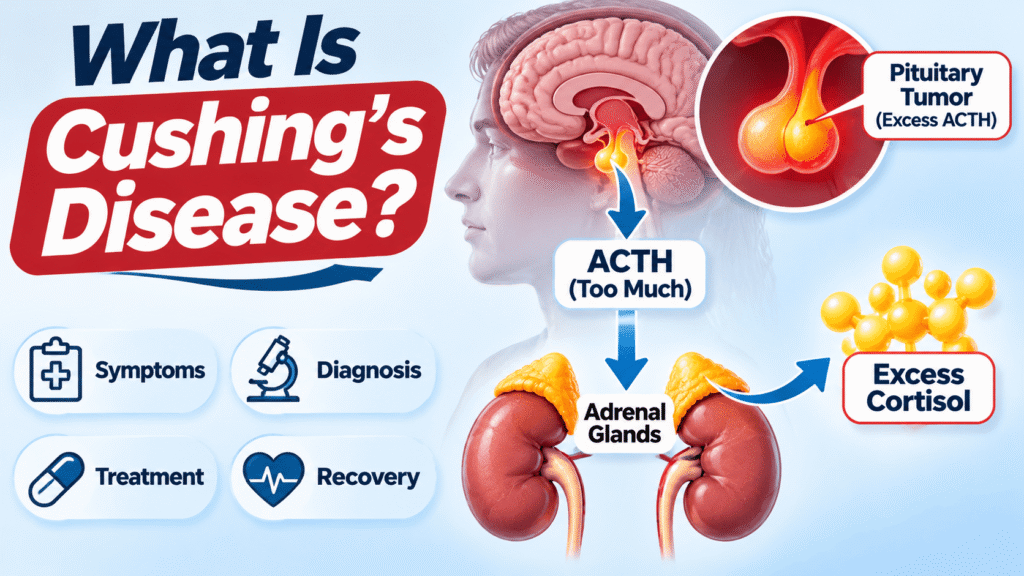
The pituitary gland sits at the base of the brain and acts like a control center for several hormones. Normally, it releases ACTH (adrenocorticotropic hormone) in small, regulated bursts. ACTH travels to the adrenal glands, two small glands that sit on top of your kidneys, and tells them how much cortisol to produce.
In Cushing’s disease, a tumor on the pituitary gland (almost always benign) produces too much ACTH. This constant signal pushes the adrenal glands to pump out excess cortisol, even when the body doesn’t need it.
Is Cushing’s Disease a Type of Cushing’s Syndrome?
Yes. Cushing’s disease is one specific cause of a larger condition called Cushing’s syndrome. Cushing’s syndrome refers to any case of prolonged excess cortisol, regardless of the cause. We’ll break down the difference in more detail later in this guide.
What Are the Symptoms of Cushing’s Disease?
Cushing’s disease symptoms tend to develop slowly, which is part of why it can be tricky to spot early on.
Early Signs of Cushing’s Disease
Gradual weight gain is often one of the first things people notice, especially around the midsection and face. Fatigue is common too, along with slow but noticeable changes in appearance. Muscle weakness, particularly in the arms and legs, tends to show up around the same time.
Common Physical Symptoms
As the condition progresses, physical symptoms become more distinct. These include:
- Increased fat around the abdomen and upper back
- A rounded, fuller facial appearance
- Wide, purple or reddish stretch marks
- Easy bruising and thinner skin
- Weakness in the shoulders, hips, and thighs
- High blood pressure
- Elevated blood sugar
Hormonal and Reproductive Symptoms
Excess cortisol disrupts other hormones too. Women may notice irregular periods or excess facial and body hair. Men may experience reduced libido or erectile difficulties. These changes happen because high cortisol interferes with the body’s normal hormone balance, not because of a separate problem.
Emotional and Mental Health Symptoms
Cushing’s disease doesn’t just affect the body. It can take a toll on mental health too. Depression, anxiety, irritability, trouble sleeping, and difficulty concentrating are all documented symptoms. These changes often improve once cortisol levels come back down.
It’s worth noting that none of these symptoms are unique to Cushing’s disease on their own. Many overlap with other health conditions, which is one reason diagnosis can take time.
What Causes Cushing’s Disease?
Understanding the root cause helps explain why treatment focuses on the pituitary gland rather than the adrenal glands themselves.
ACTH-Producing Pituitary Tumors
Cushing’s disease is caused by a tumor on the pituitary gland that secretes excess ACTH. These tumors, called adenomas, are almost always noncancerous. They’re often quite small, sometimes just a few millimeters, but even a tiny tumor can produce enough extra ACTH to cause significant symptoms.
How Excess ACTH Leads to High Cortisol
Here’s the chain reaction: the tumor releases too much ACTH, the ACTH travels through the bloodstream to the adrenal glands, and the adrenal glands respond by producing more cortisol than the body needs. Over time, this steady overproduction leads to the physical and emotional symptoms described above.
Who Is More Likely to Develop Cushing’s Disease?
Cushing’s disease is rare. It tends to affect women more often than men, and it’s most commonly diagnosed in adults between 20 and 50 years old. Beyond this, there isn’t strong evidence pointing to specific lifestyle or environmental risk factors, so it’s not something you can reliably predict or prevent.
Cushing’s Disease vs. Cushing’s Syndrome: What’s the Difference?
These two terms get mixed up constantly, so it helps to see them side by side.
| Feature | Cushing’s disease | Cushing’s syndrome |
|---|---|---|
| Definition | A specific pituitary cause of excess cortisol | The broader condition caused by prolonged excess cortisol |
| Main cause | ACTH-producing pituitary tumor | Several causes, including medications and hormone-producing tumors |
| Cortisol | Elevated | Elevated |
| Treatment | Usually pituitary-directed treatment | Depends on the underlying cause |
| Relationship | A type of Cushing’s syndrome | Includes Cushing’s disease |
In short: every case of Cushing’s disease is a form of Cushing’s syndrome, but not every case of Cushing’s syndrome is Cushing’s disease.
Can You Have Cushing’s Syndrome Without Cushing’s Disease?
Yes, and this is actually common. The most frequent cause of Cushing’s syndrome isn’t a pituitary tumor at all. It’s long-term use of corticosteroid medications, which are prescribed for conditions like asthma, arthritis, and autoimmune disorders. Other causes include tumors on the adrenal glands themselves, or rare tumors elsewhere in the body that produce ACTH outside the pituitary gland (known as ectopic ACTH production).
How Is Cushing’s Disease Diagnosed?
Diagnosing Cushing’s disease usually involves a combination of tests, since no single test tells the whole story.
Medical History and Physical Examination
Your doctor will start by asking about your symptoms, how long you’ve had them, and any medications you’re taking, especially corticosteroids. A physical exam looks for the visible signs described earlier, like stretch marks, bruising, and changes in fat distribution.
Cortisol Tests Used to Detect Cushing’s Syndrome
Several tests help confirm whether cortisol levels are genuinely elevated. The late-night salivary cortisol test checks cortisol when it should naturally be at its lowest. The 24-hour urinary free cortisol test measures total cortisol output over a full day. The dexamethasone suppression test checks whether a dose of synthetic steroid properly suppresses cortisol production, which it normally should.
ACTH Blood Tests
Once high cortisol is confirmed, an ACTH blood test helps pinpoint the source. High ACTH levels point toward a pituitary or ectopic cause, while low ACTH levels suggest the problem lies in the adrenal glands themselves.
Pituitary MRI and Additional Testing
If a pituitary tumor is suspected, an MRI of the pituitary gland is used to look for it directly. In some cases, the tumor is too small to see clearly on imaging. When that happens, doctors may use a more specialized test called inferior petrosal sinus sampling, which measures ACTH levels directly from veins near the pituitary gland.
Why Diagnosis Can Take Time
Cortisol levels naturally fluctuate, and symptoms vary quite a bit from person to person. Doctors need to confirm both that cortisol is truly elevated and where the excess is coming from before starting treatment. This careful approach takes time, but it matters, since treatment differs significantly depending on the cause.
How Is Cushing’s Disease Treated?
Treatment focuses on removing or shrinking the source of excess ACTH and bringing cortisol levels back to normal.
Pituitary Surgery
Transsphenoidal surgery, which removes the tumor through the nose and sinus cavity, is generally the preferred first-line treatment when the tumor is accessible. This approach avoids cutting through the skull and typically offers a good chance of remission when performed by an experienced surgeon.
Medications That Help Control Cortisol
When surgery isn’t an option, doesn’t fully resolve the problem, or while a patient is waiting for surgery, medications can help. Some drugs reduce cortisol production directly, while others block cortisol’s effects on the body. Your doctor will determine which medication, if any, fits your specific situation.
Radiation Therapy
Radiation therapy may be used when surgery isn’t possible, doesn’t fully remove the tumor, or when the disease persists afterward. It works gradually, often taking months or longer to bring cortisol levels down.
What Happens If Treatment Doesn’t Work?
If initial treatment doesn’t resolve the condition, doctors may recommend a second surgery in appropriate cases. In certain situations, removing both adrenal glands (bilateral adrenalectomy) may be considered, though this requires lifelong hormone replacement afterward.
Is Cushing’s Disease Curable?
Successful pituitary surgery can lead to remission for many people, meaning cortisol levels return to normal and symptoms improve. That said, outcomes depend on several factors, including the size and location of the tumor and how completely it was removed.
Recurrence is possible, even years after successful treatment. Because of this, ongoing hormone monitoring and regular follow-up appointments are an important part of long-term care, not just a formality after surgery.
What Happens If Cushing’s Disease Is Left Untreated?
Leaving Cushing’s disease untreated allows cortisol to stay elevated indefinitely, and that takes a real toll on the body over time. Potential complications include:
- Diabetes and cardiovascular disease
- Osteoporosis and bone fractures
- Blood clots
- Increased risk of infections
- Worsening mental health problems
These risks are part of why timely evaluation matters. The earlier Cushing’s disease is identified, the sooner treatment can begin and the lower the chance of lasting complications.
What Is Recovery Like After Cushing’s Disease Treatment?
Recovery looks different for everyone, but there are some general patterns worth knowing.
How Long Does Recovery Take?
Improvement after successful surgery is usually gradual rather than immediate. Some patients need temporary cortisol replacement medication for a period after surgery, since the body’s own cortisol production can take time to normalize once the tumor is removed.
Which Symptoms Improve After Treatment?
Blood pressure and blood sugar often improve relatively quickly. Weight loss and muscle strength tend to take longer, sometimes many months, to fully recover.
Why Is Long-Term Monitoring Important?
Even after successful treatment, recurrence is possible. Regular checkups help catch this early. Monitoring also watches for other pituitary hormone deficiencies, since the surgery or tumor itself can sometimes affect nearby hormone-producing cells.
When Should You See a Doctor for Possible Cushing’s Disease?
If you’re noticing a combination of symptoms, like easy bruising, wide purple stretch marks, muscle weakness, and unexplained changes in body fat, it’s worth talking to a doctor. These symptoms together are more telling than any single one on its own.
One important note: if you’re currently taking corticosteroid medications, don’t stop them abruptly on your own. Doing so can be dangerous. Any changes to steroid medication should be guided by your doctor.
Frequently Asked Questions About Cushing’s Disease
What is the main cause of Cushing’s disease?
Cushing’s disease is caused by a tumor on the pituitary gland that produces excess ACTH. This hormone signals the adrenal glands to make too much cortisol, leading to the condition’s characteristic symptoms over time.
What are the first signs of Cushing’s disease?
Early signs often include gradual weight gain, especially around the face and midsection, persistent fatigue, and muscle weakness. These changes tend to develop slowly, which can make them easy to overlook at first.
Is Cushing’s disease life-threatening?
Left untreated, Cushing’s disease can lead to serious complications, including cardiovascular disease, diabetes, and increased infection risk. With proper diagnosis and treatment, most people see significant improvement in their health.
Can Cushing’s disease cause weight gain?
Yes. Weight gain, particularly around the abdomen, face, and upper back, is one of the most common symptoms. It happens because excess cortisol affects how the body stores and distributes fat.
Is Cushing’s disease the same as Cushing’s syndrome?
No. Cushing’s disease specifically refers to cases caused by a pituitary tumor. Cushing’s syndrome is the broader term for any condition involving prolonged excess cortisol, regardless of the underlying cause.
Can Cushing’s disease be cured permanently?
Successful pituitary surgery can lead to long-term remission for many patients, though outcomes vary. Recurrence is possible, so ongoing monitoring remains an important part of care even after treatment.
How rare is Cushing’s disease?
Cushing’s disease is considered rare and is diagnosed more often in women than men, typically between the ages of 20 and 50. Because it’s uncommon, diagnosis can sometimes take longer than other conditions.
What happens to cortisol levels after treatment?
After successful treatment, cortisol levels usually drop toward normal. Some patients need temporary cortisol replacement medication afterward, since the body’s natural production can take time to recover fully.
Final Thoughts on Cushing’s Disease
Cushing’s disease develops when a pituitary tumor pushes cortisol levels too high for too long, affecting everything from your metabolism to your mood. Diagnosis takes time because symptoms overlap with other conditions, but getting an accurate diagnosis matters since it determines the right treatment path. With surgery, medication, or radiation therapy, many people see real improvement.
If you’re noticing symptoms that match what’s described here, talk to a doctor. Getting checked early is the best way to understand what’s going on and figure out the right next step.