Quick answer: Testing too soon after unprotected sex can produce a false negative result. Most STDs require a “window period” of 1 day to 3 months before they show up accurately on a test. The right time to test depends on which infection you’re concerned about.
So, something happened. Maybe a condom broke, or you had sex without protection, and now you’re worried. You want answers—fast. That’s completely understandable.
But here’s the thing: rushing to get tested the next morning might not actually tell you anything useful. STD tests don’t work like pregnancy tests, where you get a clear answer within days. Most infections need time to build up in your body before a test can detect them.
This guide breaks down exactly when to test for each major STD, what to do right after unprotected sex, and where to go for help—no judgment, no jargon.
Why Testing Too Early Can Give a False Negative
A false negative means the test says you’re clean when you might not be. And it happens more often than people realize.
Here’s why: when you’re exposed to an STD, your body doesn’t immediately produce enough of the virus, bacteria, or antibodies for a test to pick up. There’s a gap between the moment of exposure and when a test can reliably detect infection. That gap is called the window period.
Think of it like baking a cake. You can’t open the oven after two minutes and expect it to be done. You have to wait.
If you test during the window period and get a negative result, it doesn’t mean you’re in the clear. It just means it’s too early to know.
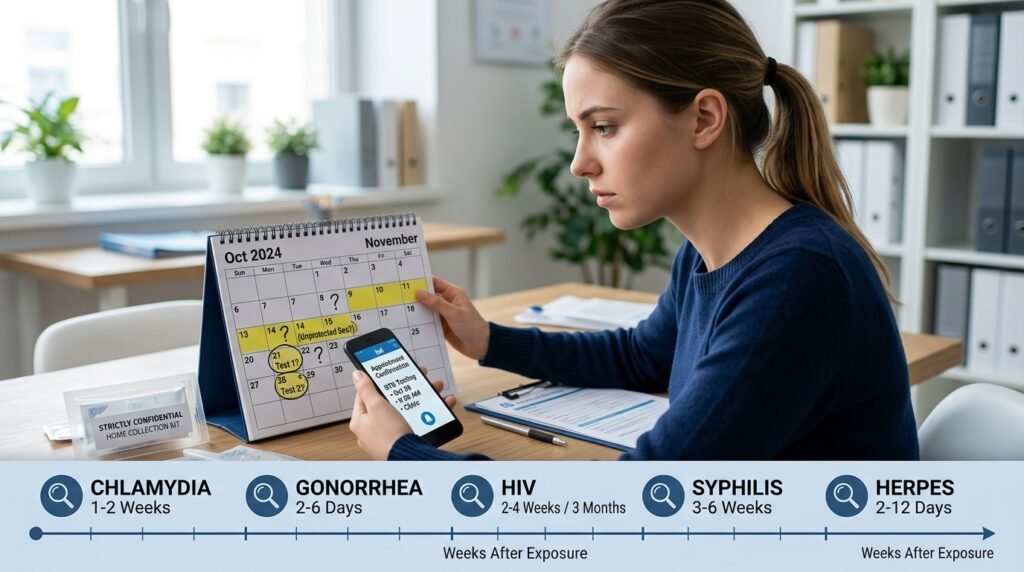
STD Testing Timelines by Infection
Every STD has its own window period. Here’s a breakdown of the most common ones.
Chlamydia and Gonorrhea (1–2 Weeks)
These are two of the most common bacterial STDs. The good news? They have one of the shorter window periods.
- When to test: 1–2 weeks after exposure
- Test type: Urine sample or swab (throat, genital, or rectal)
Both infections are highly treatable with antibiotics. Testing at the 2-week mark is generally considered reliable.
HIV (10 Days–3 Months, Depending on Test Type)
HIV testing is more complicated because there are different types of tests—and each has a different window period.
- 4th generation antigen/antibody test (most common): Accurate at 18–45 days; conclusive at 45 days for most people
- RNA/NAT test (nucleic acid test): Can detect HIV as early as 10–33 days after exposure—this is the earliest-detection option
- 3rd generation antibody-only test: Takes up to 90 days to be conclusive
Most clinics use the 4th generation test. If you had a high-risk exposure, a 45-day test followed by a 90-day confirmatory test is the standard recommendation.
Syphilis (3–6 Weeks)
Syphilis is a bacterial infection that spreads through sexual contact and can cause serious health problems if left untreated.
- When to test: 3 weeks after exposure for an initial result; retest at 6 weeks for confirmation
- Test type: Blood test
Early-stage syphilis is easily cured with penicillin. But it’s sneaky—it can be completely symptom-free for years.
Herpes (HSV-1 and HSV-2) (4–6 Weeks)
Herpes testing is probably the trickiest one to navigate, and it’s worth being upfront about that.
- When to test: 4–6 weeks after exposure for a blood antibody test; up to 4 months for the most accurate result
- Active sore present? A swab of the sore gives a faster, more accurate diagnosis
Blood tests for herpes look for antibodies, and those take time to develop. A negative result before the 12-week mark isn’t fully conclusive.
Hepatitis B and C (4–6 Weeks to Several Months)
Both hepatitis B and C can be sexually transmitted, though hepatitis C is more commonly spread through blood-to-blood contact.
- Hepatitis B: Window period of 4–6 weeks; a 3-month test is considered conclusive
- Hepatitis C: Window period of 8–11 weeks; most accurate at 6 months
If you’ve never been vaccinated for hepatitis B, now is a good time to talk to a healthcare provider.
Trichomoniasis (5–28 Days)
Trichomoniasis (or “trich”) is caused by a parasite and is one of the most common—and most overlooked—STDs.
- When to test: 5–28 days after exposure
- Test type: Urine sample or genital swab
It’s very treatable with a single round of antibiotics. Many people have no symptoms at all, which makes testing even more important.
What to Do Immediately After Unprotected Sex
Before you even think about testing, there are a couple of urgent steps worth knowing about.
Emergency contraception: If pregnancy is a concern, emergency contraception (like Plan B) works best within 72 hours of unprotected sex. The sooner, the better.
PEP for HIV exposure: If you think you may have been exposed to HIV, PEP (post-exposure prophylaxis) is a medication you can take to significantly reduce your risk. The critical window is within 72 hours of exposure—after that, it’s no longer effective. Go to an emergency room, urgent care, or call your doctor immediately if this applies to you.
Baseline testing: Some clinics recommend getting a baseline STD panel done right after exposure, even knowing results may be inconclusive. This helps establish a starting point and can catch any pre-existing infections you weren’t aware of.
Recommended Testing Schedule
Not sure when to test? Here’s a simple timeline to follow after unprotected sex:
- Right away (Day 1–3): Seek PEP if you’re concerned about HIV; consider baseline testing
- 2 weeks post-exposure: Test for chlamydia and gonorrhea
- 6 weeks post-exposure: Test for syphilis, herpes, hepatitis B and C, and HIV (4th gen test)
- 3 months post-exposure: Confirmatory HIV and syphilis test; hepatitis C if not already done
Some people only need one round of testing. Others, particularly after a higher-risk exposure, should follow the full schedule to be sure.
Should You Get Tested Even Without Symptoms?
Yes—and this point really matters.
Many STDs produce zero symptoms, sometimes for months or even years. Chlamydia is often called a “silent” infection because most people don’t know they have it. The same goes for gonorrhea, syphilis in early stages, and HIV.
Waiting for symptoms to appear is a common mistake. By the time you notice something, the infection may have already been present for a while—and potentially passed on to a partner.
Regular STD screening is recommended for anyone who is sexually active, especially if you have multiple partners or don’t consistently use condoms. Getting tested isn’t just about protecting yourself—it protects the people you’re intimate with too.
Where to Get Tested
You have more options than you might think.
- Sexual health clinics: Often free or low-cost, confidential, and staffed by specialists
- Planned Parenthood: Offers full STD panels, sliding-scale fees, and non-judgmental care
- Your primary care doctor or OB-GYN: A comfortable option if you have an established provider
- Urgent care centers: Good for quick access, though not always as specialized
- At-home STD test kits: Brands like Everlywell, myLAB Box, and LetsGetChecked let you test privately at home and mail samples to a certified lab. Results are typically available in a few days.
If cost is a barrier, many local health departments offer free or reduced-price testing. Search “free STD testing near me” or visit gettested.cdc.gov to find a location.
When to Talk to a Doctor First
If you’re experiencing symptoms—discharge, sores, burning when you urinate, or unusual rashes—don’t wait for a scheduled test. See a healthcare provider right away.
Some symptoms can indicate an active infection that needs treatment sooner rather than later. And if you’re worried about a specific exposure (especially HIV or syphilis), speaking with a doctor first helps ensure you’re on the right testing timeline and know about options like PEP.
Frequently Asked Questions
Can I test the next day after unprotected sex?
You can, but the results won’t be reliable for most STDs. Testing the next day is too early for the infection to show up—you’ll likely get a false negative. The only exception is if you already have symptoms, in which case a swab test can help identify an active infection.
What’s the most accurate STD test?
It depends on the infection. For HIV, the 4th generation antigen/antibody blood test is the most commonly used and highly accurate after 45 days. For chlamydia and gonorrhea, a urine test or swab is very reliable. For herpes, a swab of an active sore is more accurate than a blood test.
Do I need to retest after a negative result?
Sometimes, yes. If you test before the window period closes, a follow-up test is important. For HIV and syphilis in particular, a second test at the 3-month mark is recommended after any high-risk exposure, even if the first result was negative.
How long should I wait to have sex again after potential exposure?
There’s no universal rule, but it’s sensible to wait until you’ve completed your testing schedule and received clear results. If you do have sex before then, using condoms reduces the risk of passing on an infection you may not know you have yet.
Is it possible to have an STD and test negative every time?
A persistently false negative is unlikely if you test outside the window period using the right test. However, no test is 100% perfect. If you have ongoing concerns, talk to a doctor about the most appropriate testing method for your situation.