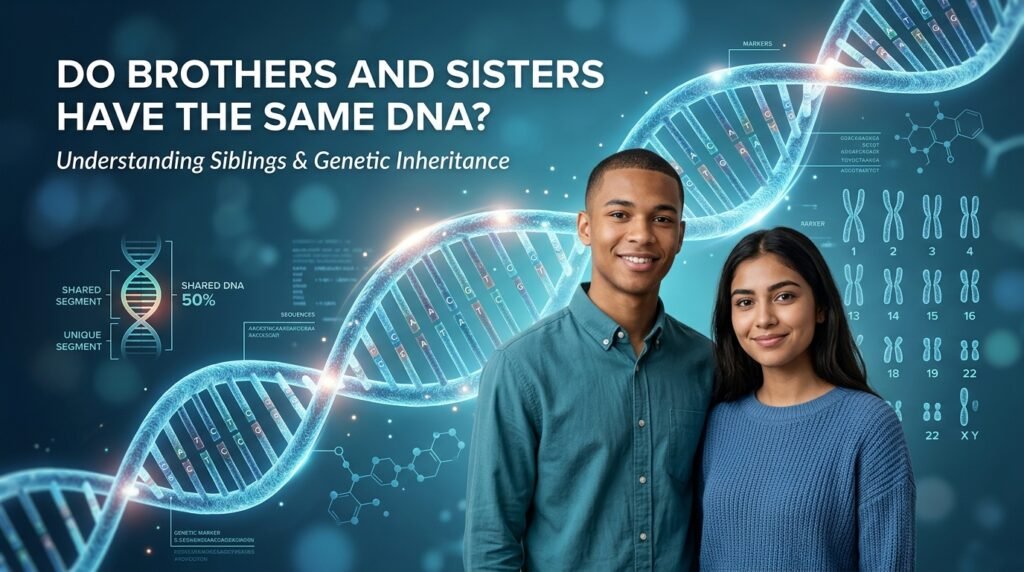
Quick answer: No, a brother and sister do not have the same DNA. Full siblings share about 50% of their DNA on average, but each child inherits a unique mix of genes from their parents. The only exception is identical twins, who share nearly 100% of their DNA.
Have you ever looked at your sibling and thought, “How are we even related?” Maybe they got the curly hair while you got straight. Or they’re tall and you’re not. It happens in almost every family.
Here’s the thing—you and your brother or sister came from the same two parents. So shouldn’t your DNA match? Not quite.
Full siblings share roughly half of their DNA. That’s a lot, but it’s far from a perfect copy. Each of you got your own special blend of genes, which is why no two siblings (except identical twins) are exactly alike.
In this post, you’ll learn how much DNA siblings really share, why each child turns out different, and what DNA tests can and can’t tell you about family relationships. Let’s dig in.
Quick Answer: How Much DNA Do Brothers and Sisters Share?
Let’s keep it simple. Here’s what you need to remember.
Key takeaways:
- Full siblings share about 50% of their DNA.
- Half-siblings share about 25%.
- Identical twins share nearly 100%.
- DNA sharing can vary a little from one sibling pair to the next.
Want a clearer picture? This table breaks it down.
| Relationship | Average DNA Shared |
|---|---|
| Identical twins | Nearly 100% |
| Full siblings | About 50% |
| Half-siblings | About 25% |
| Parent and child | About 50% |
| First cousins | About 12.5% |
Notice something interesting? A parent and child share about 50%, just like full siblings. But the way that DNA is passed down is very different, which we’ll explain next.
Why Don’t Brothers and Sisters Have Identical DNA?
You’d think kids from the same parents would be genetic twins. But nature loves to mix things up. Here’s why.
How DNA Is Inherited From Parents
Every person has 46 chromosomes. Think of chromosomes as tiny instruction books that hold your genes.
You get 23 of these books from your mother and 23 from your father. Together, they make the full set of 46.
But here’s the catch. Your mom and dad each carry two copies of every chromosome. They only pass one copy to each child—and which copy gets passed is basically random.
So your brother might get a different copy than you did. That’s where the differences begin.
Genetic Recombination Explained
Before a baby is even conceived, something cool happens. The chromosomes shuffle.
This shuffling is called recombination. Picture two decks of cards being mixed before being dealt. Each child gets a freshly shuffled hand.
That’s why every child receives a unique DNA mix. Your parents could have a hundred kids, and not one would be genetically identical to another.
Why Siblings Can Look Similar Yet Be Different
So why do some siblings look like clones while others seem like strangers?
It comes down to which genes they share and which they don’t. You might share the genes for eye color but not for height. Your sister might get your dad’s smile but your mom’s hair.
Then there’s the world around you. Diet, sleep, lifestyle, and environment all shape how you turn out, too. Genes set the stage, but life writes part of the story.
How Much DNA Do Full Siblings Share?
We keep saying “about 50%.” But what does that actually mean? Let’s unpack it.
The Average Is About 50%
When we say full siblings share 50% of their DNA, we mean half of their genetic markers tend to match.
It’s an average, not a strict rule. Think of it like flipping a coin many times. You’ll get close to half heads and half tails, but rarely exactly half.
Can Siblings Share More or Less Than 50%?
Yes, and this surprises a lot of people.
Because of that random shuffling, some siblings share a bit more than 50%, and others share a bit less. Most fall somewhere between 40% and 60%.
This is why one brother might feel “closer” to a sibling genetically than another. It’s all down to chance and how the genes were dealt.
Real DNA Testing Examples
DNA tests measure shared DNA using a unit called centimorgans, or cM for short. Don’t worry about the science—just think of it as a way to count how much DNA two people have in common.
Full siblings usually share somewhere around 1,600 to 3,400 cM. That’s a wide range, and it shows just how much sibling DNA can vary. Half-siblings, by comparison, share far less.
Do Brothers and Sisters Have the Same DNA Test Results?
Nope. If you and your sibling both took an ancestry test, your results could look pretty different. Here’s why.
Why Sibling DNA Results Differ
Remember the shuffling? You each inherited different segments of DNA from your parents.
So even though you have the same mom and dad, you didn’t get the same pieces. That leads to different results on a DNA test.
Differences in Ancestry Reports
This is one of the most common surprises in DNA testing.
Let’s say your family has roots in Italy, Ireland, and Nigeria. One sibling might show more Italian heritage, while another shows more Irish. You both have the same ancestors—you just inherited different amounts from each.
Health and Trait Reports
DNA tests can also flag health risks and predict traits like eye color or taste preferences.
Since siblings carry different gene combinations, these reports can differ, too. One sibling might carry a certain genetic risk while another doesn’t. It doesn’t mean a mistake was made—it just reflects your unique DNA.
Can a Brother and Sister Have Exactly the Same DNA?
There’s only one real exception to everything we’ve covered. Let’s talk about it.
The Exception: Identical Twins
Identical twins start as a single fertilized egg that splits into two.
Because they come from the same egg and sperm, they share nearly identical DNA. That’s why they look so alike and are often hard to tell apart.
Keep in mind, though—even identical twins can develop tiny genetic differences over time. But for the most part, their DNA is a near-perfect match.
Why Ordinary Siblings Are Genetically Unique
Regular siblings come from different eggs and different sperm. Each pairing creates a brand-new genetic recipe.
Add in the random shuffling, and you get a person who has never existed before and never will again. Pretty amazing when you think about it.
Do Brothers and Sisters Have the Same Blood Type?
This is a great question, and the answer is: it depends.
Sometimes Yes, Sometimes No
Blood type is inherited from your parents, just like other traits.
Siblings can absolutely share the same blood type. But they can just as easily have different ones. It all depends on the gene combinations they receive.
Why Siblings Can Have Different Blood Types
Your parents each carry two blood type genes. Depending on which ones get passed down, kids in the same family can end up with several different blood types.
So if your blood type doesn’t match your brother’s, don’t panic. It’s completely normal.
How DNA Testing Determines Whether People Are Siblings
DNA testing can do more than reveal ancestry. It can also confirm whether two people are siblings. Here’s how it works.
What Is a Sibling DNA Test?
A sibling DNA test compares the DNA of two people to see how much they share.
The more DNA they have in common, the more likely they’re related. It’s often used when a parent isn’t available for testing.
Full Sibling vs Half-Sibling Testing
The test can usually tell the difference between full siblings and half-siblings.
Full siblings share more DNA (around 50%), while half-siblings share less (around 25%). That gap helps the lab figure out the relationship.
Accuracy of Sibling DNA Tests
Sibling tests are helpful, but they’re not always as clear-cut as a parent-child test.
Because of natural variation, results can sometimes be a little uncertain. Including a parent’s DNA in the test, when possible, makes the results far more reliable.
When Sibling Testing Is Used
People turn to sibling DNA tests for several reasons, such as:
- Family verification—confirming a biological relationship
- Immigration cases—proving family ties for visa or residency claims
- Missing parent situations—when a parent can’t be tested
- Inheritance claims—settling questions about an estate
Can DNA Prove That Two People Are Brother and Sister?
Yes, but with a few caveats. Let’s look at what’s possible and where the limits are.
What DNA Tests Can Confirm
A DNA test can show a strong likelihood that two people are siblings.
When the shared DNA falls in the expected range, the test can confirm the relationship with high confidence. This is especially true for full siblings.
Limitations of Sibling Testing
Here’s where it gets tricky. Because sibling DNA can vary so much, some results land in a gray zone.
Two people might share an amount of DNA that could fit either a full-sibling or half-sibling relationship. In those cases, a single test isn’t always enough.
Additional Tests That May Be Needed
To clear things up, labs may suggest extra tests, including:
- Parent testing—adding a known parent’s DNA for comparison
- Grandparent testing—using a grandparent’s DNA to trace the line
- Avuncular testing—comparing DNA with an aunt or uncle
These extra steps help paint a clearer family picture.
Common Myths About Sibling DNA
There’s a lot of confusion out there. Let’s clear up a few popular myths.
Myth #1: Siblings Have Identical DNA
False. Only identical twins come close to having identical DNA. Regular siblings share about half.
Myth #2: All Siblings Share Exactly 50%
Not true. The 50% figure is an average. Real sharing usually ranges from about 40% to 60%.
Myth #3: DNA Tests Cannot Confirm Sibling Relationships
Wrong. DNA tests can confirm sibling relationships, especially when a parent’s sample is included.
Myth #4: Siblings Must Have the Same Ethnicity Results
Nope. Siblings often get different ancestry breakdowns, even with the same parents. It’s all about which DNA segments each one inherited.
Frequently Asked Questions
Do brothers and sisters share the same DNA?
No. Brothers and sisters share about 50% of their DNA on average, not 100%. Each sibling inherits a unique mix of genes, so their DNA is similar but not identical. Identical twins are the only exception.
What percentage of DNA do full siblings share?
Full siblings share roughly 50% of their DNA on average. In reality, this can range from about 40% to 60% because of the random way genes are passed down from parents.
Can siblings have different ancestry results?
Yes. Siblings often get different ancestry estimates, even with the same parents. Each child inherits different DNA segments, so one sibling may show more of a certain heritage than another.
Can a DNA test prove someone is your sibling?
Yes, in most cases. A sibling DNA test compares shared DNA to confirm a relationship. Results are most accurate when a parent’s DNA is also included, since sibling DNA can vary.
Do siblings always have the same blood type?
No. Siblings can share the same blood type or have completely different ones. It depends on the blood type genes each child inherits from their parents.
Why do some siblings look completely different?
Siblings inherit different combinations of genes from the same parents. One child might get certain traits while another gets a different set. Environment and lifestyle also shape how people look.
Are brothers genetically closer to sisters than cousins?
Yes. Full siblings share about 50% of their DNA, while first cousins share only about 12.5%. So a brother and sister are far more genetically similar than cousins.
Final Verdict: Do Brothers and Sisters Have the Same DNA?
So, do brothers and sisters have the same DNA? The simple answer is no.
Full siblings share about half of their genetic material—a lot, but nowhere near a perfect match. Thanks to genetic shuffling and random inheritance, each child ends up with a one-of-a-kind DNA blend.
That’s actually something to celebrate. Every person in your family is genetically unique, even with the same parents. The only exception is identical twins, who come from the same egg.
If you’re curious about your own family connections, a DNA test can offer real answers. And if your results don’t perfectly match a sibling’s, now you know why—it’s nature doing exactly what it’s supposed to do.
Meta data
Meta description
Do brothers and sisters have the same DNA? Learn how much DNA siblings share, why each child is genetically unique, and what DNA tests really reveal.