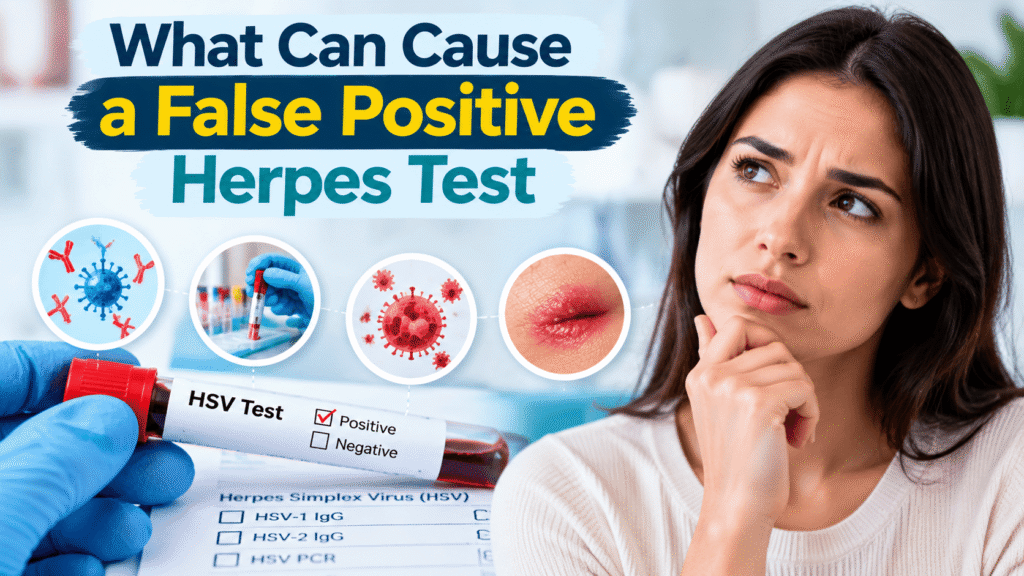
TL;DR: A positive herpes blood test (IgG) isn’t always the final answer. False positives happen because of low index values, cross-reactivity with similar viruses, early testing, or low-risk testing populations. If your result feels confusing, a confirmatory test like a Western Blot can give you clarity.
A positive result lands in your inbox. No symptoms. No warning. Just a word on a screen that changes everything in an instant.
That shock is real, and so is the anxiety that follows. Your mind races through questions you never expected to ask. But here’s something worth knowing before you spiral: standard herpes blood tests are far less reliable than most people assume.
Swab tests, taken directly from a sore or blister, are highly accurate. They detect the actual virus. Standard IgG blood tests work differently. They search for antibodies, which are proteins your immune system makes in response to infection. That difference matters, and it’s the reason false positives happen more often than you’d think.
This article breaks down exactly why that happens, what the numbers on your lab report actually mean, and what steps you can take next.
A quick note: This article is for educational purposes only. It does not replace medical advice. Always talk to a healthcare provider about your specific results and circumstances.
Why Are HSV-2 Blood Tests So Prone to Error?
Most confusion starts with a basic misunderstanding: not all herpes tests work the same way.
Antibody Tests vs. Direct Swab Tests
A swab test looks for the virus itself. If you have an active sore, a provider can swab it and test for HSV DNA directly. This method is precise and leaves little room for interpretation.
A blood test works differently. Instead of searching for the virus, it searches for IgG antibodies, which are immune system proteins your body produces to fight HSV. The test doesn’t see the virus. It sees a signal that your immune system left behind, and signals can be misread.
That interpretation gap is where false positives creep in.
What Do the CDC and FDA Say About Low-Risk Screening?
The Centers for Disease Control and Prevention (CDC) does not recommend routine herpes screening for people without symptoms and without a known risk factor, such as a partner with a confirmed diagnosis. One reason is accuracy. In low-risk populations, standard serological (blood-based) screening produces a meaningful share of false positives.
In other words: testing people who are unlikely to have HSV increases the odds that any positive result is wrong. We’ll walk through the math behind that a little further down.
What Are the Top 5 Causes of a False Positive Herpes Test?
If you’re staring at a positive result and asking “why,” here are the five most common explanations.
1. Low Positive Index Values (The “Grey Area”)
Your lab report includes a number called an index value. This number reflects how strongly your blood reacted to the HSV-2 antigen used in the test.
On common assays like HerpeSelect, index values between 1.1 and 3.5 fall into a grey zone. Results in this range carry a meaningfully higher chance of being false positives than high index values. A result of 1.2 is very different from a result of 8.0, even though both are technically labeled “positive.”
If your index value sits in that lower range, don’t treat it as a final diagnosis. Treat it as a signal that more testing is needed.
2. Cross-Reactivity With Other Viruses
Your immune system doesn’t always produce perfectly specific antibodies. Sometimes, antibodies created in response to a different virus look similar enough to HSV-2 antibodies to confuse the test.
Viruses known to cause this kind of cross-reactivity include:
- Epstein-Barr virus (EBV), the virus behind mononucleosis
- Varicella-Zoster virus, which causes chickenpox and shingles
- HSV-1, the virus most commonly associated with oral cold sores
If you’ve had any of these infections, your blood test results deserve a closer look.
3. Testing Too Soon After Exposure
Your immune system needs time to build a detectable antibody response. This window, known as the window period, typically takes several weeks to a few months after exposure.
Testing too early doesn’t just risk a false negative. It can also produce unclear or inconsistent results that require retesting down the line. If you tested shortly after a possible exposure, timing alone could explain a confusing result.
4. Interfering Proteins and Underlying Conditions
Blood tests rely on chemical reactions, and certain conditions can interfere with those reactions. Recent vaccinations, autoimmune markers, and elevated rheumatoid factor levels have all been associated with disrupted immunoassay accuracy.
This doesn’t mean something is wrong with your health. It simply means your blood chemistry, at that moment, created conditions that made the test harder to interpret correctly.
5. Low-Risk Population Demographics
This cause is about statistics, not biology, and it’s one of the most overlooked explanations.
Positive predictive value (PPV) measures the chance that a positive result is actually correct. PPV depends heavily on how common a condition is in the group being tested. When a test is given to a population where the infection is rare, even a small false positive rate can mean a large share of positive results are wrong.
If you have no symptoms and no known exposure, you fall into a lower-risk category, and that context matters when interpreting your result.
How Can You Confirm Your Herpes Test Result?
A confusing or low-positive result doesn’t have to stay confusing. Confirmatory testing exists for exactly this reason.
What Is the Western Blot Test?
The University of Washington’s Western Blot test is widely regarded as the gold-standard confirmatory test for HSV. It’s more precise than standard screening assays and is specifically designed to resolve ambiguous or borderline results.
If your initial test came back with a low index value, a Western Blot can offer real clarity.
What Are Supplemental Inhibition Assays?
Some labs, including Quest Diagnostics, offer supplemental inhibition testing. This secondary test checks whether a low-positive IgG sample is a true match or a false signal, giving you another layer of confirmation beyond the initial screening.
Should You Get a PCR Swab Test Instead?
If you ever develop a physical sore or blister, a PCR swab test is your most definitive option. It tests directly for viral DNA rather than relying on antibody interpretation, making it far more conclusive than any blood test.
Keep this in mind for the future: if symptoms appear, a swab test will give you answers faster and with more certainty.
Frequently Asked Questions
Can a yeast infection or bacterial vaginosis cause a false positive herpes blood test?
No. Local vaginal infections, like yeast infections or bacterial vaginosis, do not cause false positives on HSV blood tests. They can, however, cause symptoms that resemble a herpes outbreak, which sometimes leads people to seek testing in the first place.
If I have a low positive index value, should I panic?
No. Low positive index values, especially those between 1.1 and 3.0, frequently turn out to be false positives once confirmatory testing is done. Take a breath. This number is a starting point for more testing, not a diagnosis.
Do at-home or online lab orders have the same false-positive rates?
Yes. Commercial labs, including Quest and LabCorp, use the same standard immunoassay screening methods regardless of how you order the test. The advantage of using a private testing network is speed and discretion when it comes to accessing follow-up confirmatory testing.
How long does confirmatory testing take?
Timelines vary by lab and test type, but Western Blot and inhibition assays generally take longer than standard screening tests because they require more specialized analysis. Ask your provider or lab for an expected turnaround time.
Who should consider confirmatory testing?
Anyone with a low positive index value, no symptoms, and no known exposure risk is a strong candidate for confirmatory testing. If your result doesn’t match your personal risk profile, it’s worth the extra step.
Don’t Treat One Test as the Final Word
A single positive IgG result, especially one with no symptoms and a low index value, is not a definitive diagnosis. It’s one data point, shaped by how the test works, how your immune system behaves, and how common HSV is in your specific risk group.
Here’s what to do next:
- Talk to a healthcare provider about your specific index value and risk factors.
- Ask about a supplemental inhibition test or a Western Blot for confirmation.
- Consider a confidential lab network if you want fast, discreet retesting for peace of mind.