Quick answer: In most cases, you can’t get usable DNA from cremated ashes. The intense heat of cremation breaks down genetic material almost completely. DNA recovery from ashes is extremely rare, so if you need DNA for paternity, ancestry, or identification, you’re far better off using alternative sources like hair, stored medical samples, or testing close relatives.
Losing a loved one is hard enough. But sometimes, after a cremation, questions come up that no one expected. Maybe there’s a paternity dispute. Maybe an inheritance claim hangs in the balance. Or maybe you’re simply curious about your family roots and wish you had a sample to test.
So you start wondering: can you actually get DNA from ashes?
It’s a fair question, and a common one. People ask it for all kinds of reasons—legal battles over estates, ancestry research, or even helping identify someone. The hope is real, and so is the emotion behind it.
Here’s the truth, though. The science doesn’t offer much good news. In this article, we’ll walk through what really happens to DNA during cremation, the rare cases where recovery might be possible, and the smarter alternatives you can turn to instead.
The Short Answer: Is DNA Recoverable From Ashes?
Let’s not bury the headline. For the vast majority of cases, the answer is no.
Key takeaways:
- Most cremated ashes contain little to no usable DNA.
- Cremation temperatures destroy cellular structures and genetic material.
- Rare exceptions may exist, but they’re uncommon and far from guaranteed.
Think of DNA like a delicate paper document. Cremation is like throwing that document into a furnace. What comes out the other side isn’t a smudged copy you can still read—it’s ash. The information is gone.
What Happens to DNA During Cremation?
To understand why DNA doesn’t survive, it helps to know what cremation actually does.
How Does the Cremation Process Work?
Cremation uses extreme heat to reduce a body to bone fragments and ash.
Most crematoriums reach temperatures between 1,400°F and 1,800°F (around 760°C to 980°C). The process usually takes about one to three hours, depending on the size of the body and the equipment used.
During this time, soft tissue burns away completely. The tougher bones break down into brittle fragments. These are later ground into the fine, sand-like substance we call ashes.
Why Does High Heat Destroy DNA?
DNA is the instruction manual inside your cells. It’s a long, twisted molecule that holds all your genetic information.
But DNA is fragile. It starts breaking down at temperatures well below what cremation reaches. Heat snaps the molecular bonds that hold DNA together, scrambling the code beyond repair.
By the time cremation is done, the cells are gone, the chromosomes are destroyed, and the genetic material has essentially disintegrated. There’s nothing left to read.
What Do Cremated Ashes Actually Contain?
You might assume ashes still hold a bit of the person inside them. In a biological sense, though, they don’t hold much.
Cremated remains are mostly:
- Bone fragments
- Minerals
- Calcium phosphates
What’s missing? Intact cells and usable DNA. The heat strips all of that away, leaving behind the inorganic parts that don’t carry genetic code.
Can Any DNA Survive Cremation?
Never say never, right? There are rare situations where some genetic material might cling on. But don’t get your hopes too high.
When Might DNA Survive?
A few unusual circumstances could leave behind traces:
- Incomplete cremation: If the process was cut short, some tissue might remain.
- Large bone fragments: Bigger, denser pieces sometimes shield their interior from full heat exposure.
- Protected tissue remnants: In rare cases, small bits of tissue survive in sheltered spots.
Why Is Success So Unlikely?
Even in these rare cases, the odds are stacked against you.
The DNA that might survive is usually badly damaged. Labs need a certain quality and quantity to run a reliable test, and degraded fragments often don’t make the cut.
There’s also the cost. Specialized testing can be expensive, and you could spend a lot of money chasing a result that never comes. For most families, the math just doesn’t work out.
Can You Perform a DNA Test Using Ashes?
This is where reality meets expectation. Many people assume a lab can just “extract” DNA from ashes. The truth is more complicated.
What Do Most DNA Testing Labs Say?
Most standard DNA labs won’t test ashes at all.
These labs need good-quality samples—think cheek swabs, blood, or fresh tissue. Ashes simply don’t contain enough viable DNA to meet their requirements, so they typically reject them outright.
What About Specialized Forensic Testing?
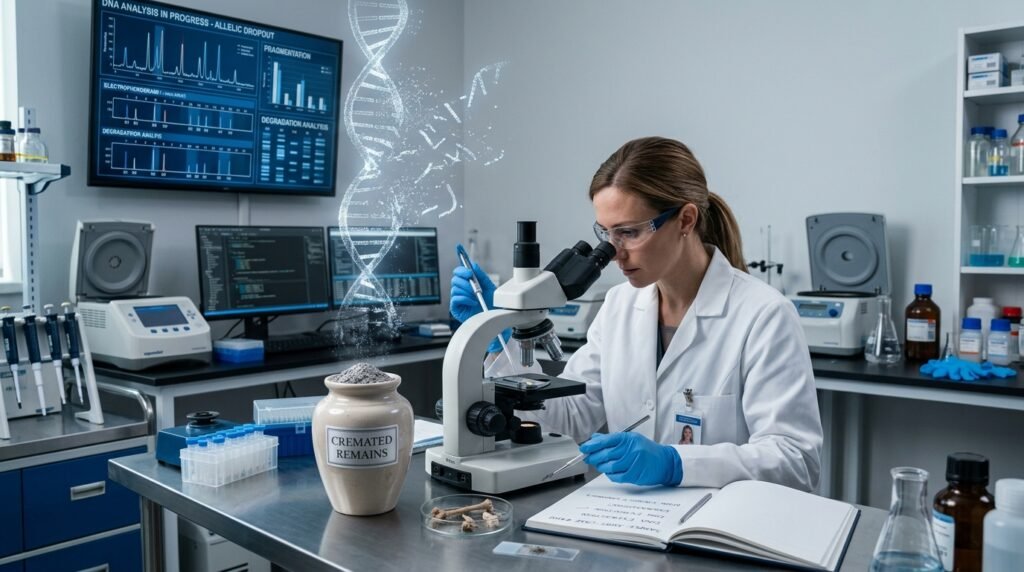
Forensic labs have more advanced tools. They use techniques designed to pull DNA from tough, degraded samples.
Still, even these specialists face steep limits. If the genetic material is destroyed, no amount of technology can recreate it. Success rates for cremated remains stay very low.
When Might Testing Actually Be Possible?
Testing has a slim chance only in specific situations:
- When preserved bone fragments survive the cremation.
- When you have access to a specialized forensic laboratory.
Even then, treat it as a long shot, not a sure thing.
Alternative Sources of DNA After Cremation
Here’s the good news. If someone has been cremated, ashes aren’t your only option. In fact, they’re usually the worst option.
There are often better, more reliable sources of DNA hiding in plain sight.
Hair Samples
Hair can be a great source—but only if it has the root attached.
The root holds cells with usable DNA. A plain hair shaft, like a strand cut from a haircut, usually doesn’t have enough genetic material to test. So check old hairbrushes carefully.
Stored Medical Samples
Hospitals and clinics sometimes keep biological samples for years.
These might include:
- Blood samples
- Biopsy tissue
- Pathology specimens
It’s worth contacting their old doctor or hospital to ask. You might be surprised by what’s on file.
Personal Items
Everyday objects can hold a person’s DNA long after they’re gone.
Look for:
- Toothbrushes
- Razors
- Dentures
- Fingernail clippings
These items often carry cells from saliva, skin, or blood. Store them in a clean paper bag and avoid plastic, which can trap moisture and degrade the sample.
Preserved Biological Material
If the person had surgery or a medical procedure, preserved tissue samples may still exist in a lab or pathology archive. These can be excellent sources for testing.
Can You Determine Paternity From Ashes?
Paternity disputes are one of the most common reasons people ask about DNA in ashes. Sadly, ashes rarely help here.
Why Ashes Usually Don’t Work for Paternity Testing
Paternity tests need clean, intact DNA to compare genetic markers between a parent and child.
Since cremation destroys that DNA, ashes can’t provide the data the test needs. The sample just isn’t there to work with.
How Else Can You Establish Paternity?
Don’t lose hope. You can often answer paternity questions by testing living relatives instead.
Options include:
- Grandparent DNA testing: Comparing a child’s DNA with the alleged father’s parents.
- Sibling DNA testing: Comparing DNA between possible siblings.
- Avuncular DNA testing: Testing aunts or uncles to find a genetic link.
These tests can’t always give a perfect yes-or-no answer, but they often come close. For many families, they’re the most practical path forward.
Can Ashes Be Used for Ancestry DNA Testing?
If you’re researching your family tree, you might wonder if a relative’s ashes could fill a gap. Unfortunately, the answer is almost always no.
What Do Ancestry Tests Require?
Ancestry tests like AncestryDNA and 23andMe need high-quality DNA, usually from a simple saliva sample.
Cremated remains can’t meet that standard. They lack the intact genetic material these tests depend on, so they’ll typically fail.
What Are Better Alternatives for Family Research?
For ancestry work, focus on what’s still available:
- Living relatives: A close relative’s DNA can reveal a lot about shared ancestry.
- Existing DNA profiles: Maybe the person was tested with a service while alive.
- Family records: Birth certificates, marriage records, and old documents fill in the rest.
DNA From Bone Fragments vs. Ashes: What’s the Difference?
Not all remains are created equal. There’s a big gap between an uncremated bone and a pinch of ash.
Uncremated Bone Samples
Bones that haven’t been cremated can hold DNA for a long time—sometimes years or even centuries.
This is why forensic teams and archaeologists often recover genetic material from skeletal remains. The DNA hides deep inside the bone, protected from the elements.
Cremated Bone Fragments
Once bone goes through cremation, that protection is gone.
The heat damages the DNA inside, leaving very little to recover. Even with advanced tools, scientists face major challenges pulling usable genetic material from cremated fragments.
Here’s a quick comparison to put it all in perspective:
| Sample Type | DNA Recovery Likelihood |
|---|---|
| Fresh tissue | Very High |
| Blood sample | Very High |
| Tooth | High |
| Hair with root | Moderate to High |
| Bone (uncremated) | Moderate |
| Cremated ashes | Extremely Low |
What Do Forensic Experts Say About DNA in Ashes?
The people who work with DNA every day tend to agree on this topic.
What Does Scientific Research Show?
Research consistently points to the same conclusion: cremation destroys most usable DNA.
Labs report very low success rates when trying to extract genetic material from cremated remains. The high heat is simply too much for the fragile molecule to survive.
How Is DNA Used in Real Forensic Work?
Forensic experts do recover DNA in tough situations—but the source matters.
In disaster victim identification, teams often work with bones and teeth that weren’t cremated. The same goes for archaeological digs and criminal investigations. They rely on bone and tooth samples, not ashes, because those hold up far better over time.
Frequently Asked Questions
Can a DNA test be performed on cremated ashes?
In almost all cases, no. Standard DNA labs reject ashes because they lack usable genetic material. The heat of cremation destroys the DNA needed for testing.
Does any DNA survive cremation?
Rarely. Some traces might survive if cremation was incomplete or if large bone fragments protected the interior. Even then, the DNA is usually too damaged to test reliably.
Can paternity be established from ashes?
Not usually. Cremation destroys the DNA needed for paternity testing. A better approach is to test living relatives, such as grandparents, siblings, aunts, or uncles.
Can a laboratory extract DNA from bone fragments found in ashes?
It’s extremely unlikely. While uncremated bone can hold DNA, cremated bone fragments have lost most of theirs to the heat. Only specialized forensic labs would even attempt it, and success is rare.
How hot does cremation get?
Cremation typically reaches between 1,400°F and 1,800°F (about 760°C to 980°C). That’s far hotter than the temperature at which DNA starts to break down.
What personal items can be used instead of ashes for DNA testing?
Toothbrushes, razors, dentures, hairbrushes with rooted hair, and fingernail clippings can all carry DNA. Stored medical samples like blood or biopsy tissue are also strong options.
Are there companies that claim to recover DNA from ashes?
Be cautious here. If a company promises reliable DNA recovery from cremated ashes, treat that claim with scepticism. The science strongly suggests this isn’t possible in most cases, so ask plenty of questions before paying anything.
Final Verdict: Can You Get DNA From Ashes?
Let’s bring it home. For nearly everyone asking this question, the answer is no.
Standard cremation destroys DNA. The extreme heat breaks down the genetic material so completely that usable DNA seldom survives. Recovery from ashes is possible only in rare, unusual cases—and even then, it’s far from guaranteed.
But that doesn’t mean you’re out of options.
If you need DNA for paternity, ancestry, or identification, look elsewhere. Personal items, stored medical samples, and testing close relatives can all give you reliable results. These paths are cheaper, more practical, and far more likely to succeed.