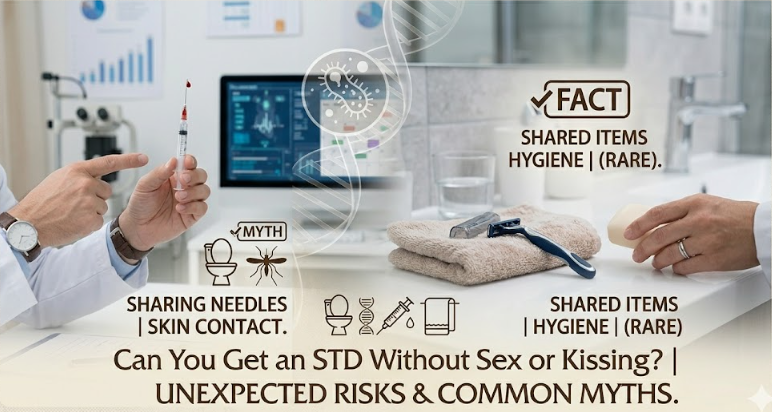
Can You Contract an STD Without Sexual Contact? I hear this question a lot. Many people worry about picking up an infection from a public restroom or a shared towel. It is completely normal to feel a little anxious about accidental transmission.
The quick answer is yes. You can get an STD without having sex. But it does not happen the way most people think.
We will look at what science says about non-sexual STI transmission. You can put your mind at ease and learn how to stay safe.
How Do You Get an STD Without Having Sex?
We usually associate sexually transmitted diseases with intercourse. But some infections spread through other means. Here is how indirect STD transmission actually happens.
Skin-to-Skin Contact
You do not need to exchange bodily fluids to catch certain infections. Getting an STD from skin contact is very real. Viral infections like HPV (warts) and Molluscum Contagiosum spread through simple touch. If infected skin rubs against broken skin, the virus can spread.
Mother-to-Child
We call this vertical transmission. A mother can pass an infection to her baby during pregnancy or childbirth. This includes infections like Syphilis, HIV, and Hepatitis B.
Shared Needles
Sharing needles is very risky. It directly introduces infected blood into your bloodstream. This is a common way to transmit HIV, Hepatitis B, and Hepatitis C.
Breastfeeding
Some viruses live in breast milk. HIV can be passed to a baby this way. Medical professionals often advise mothers with HIV to use formula instead.
Blood Transfusions
This is extremely rare in the United States today. Blood banks use rigorous screening protocols. Historically, however, blood transfusions were a known risk for HIV and Hepatitis.
The Indirect Contact Debate: Towels, Razors, and Laundry
Can you catch an infection from household items? It depends on the item and the infection. Let’s look at the facts.
Towels and Laundry
There is a link between sharing towels and STDs. Parasites like pubic lice (crabs) and scabies can survive for a short time off the human body. They live on “fomites.” These are objects like towels, bedsheets, or clothing. If you use a towel right after an infected person, you might catch these parasites.
Razors
You should never share a razor. Shaving causes tiny cuts on your skin. These cuts create a path for bloodborne pathogens. Sharing a razor increases your risk of catching Hepatitis B or C.
Toothbrushes
This is the toothbrush myth. Sharing a toothbrush is gross, but the STD risk is incredibly low. However, if you share a toothbrush with someone who has bleeding gums, you could theoretically catch a bloodborne virus. It is always best to use your own toothbrush.
Debunking the Top 3 STD Myths
Anxiety often leads to misinformation. Let’s clear up some common fears using data from organizations like the World Health Organization (WHO).
Here is a quick breakdown of how infections spread:
- Toilet Seats: No
- Shared Needles: Yes
- Skin Contact: Yes
- Swimming Pools: No
Myth 1: Toilet Seats
Can you get an STD from a toilet seat? No. STIs like Chlamydia or Gonorrhea cannot survive long on cold, hard surfaces. The bacteria die almost immediately when they leave the body. You are safe using public restrooms.
Myth 2: Swimming Pools and Hot Tubs
You cannot catch an STD from a pool. Chlorine and other pool chemicals kill the bacteria and viruses that cause STDs. Water dilutes any remaining pathogens, making transmission impossible.
Myth 3: Mosquitoes
Insects do not carry STDs. A mosquito cannot transmit HIV or herpes. The virus does not survive inside the mosquito’s body.
Infections Often Mistaken for STDs
Sometimes you might experience itching, burning, or unusual discharge. You might panic and assume it is an STD. But several conditions mimic STD symptoms without being sexually transmitted.
Bacterial Vaginosis (BV)
BV happens when the normal bacteria in the vagina get out of balance. It causes an odor and discharge. You do not need to have sex to get BV.
Yeast Infections
Yeast infections are very common. They happen when a fungus overgrows. This can be caused by taking antibiotics, wearing wet swimsuits, or changes in your diet. It is not an STD.
Urinary Tract Infections (UTIs)
UTIs cause a painful burning feeling when you pee. Sex can push bacteria into the urethra and trigger a UTI. However, UTIs are not classified as STDs. You can get them from holding your urine too long or wiping incorrectly.
Frequently Asked Questions
Can I get herpes from sharing a drink?
HSV-1 is the virus that causes cold sores. It can spread through saliva. If you share a drink with someone who has an active cold sore, you could catch HSV-1. However, HSV-2 (genital herpes) does not spread this way.
Can you get an STD from a gym bench?
You cannot catch an STD by sitting on a sweaty gym bench. Viruses and bacteria do not survive well on vinyl or metal. You should still wipe down equipment for basic hygiene, but you will not catch an STI this way.
Is it possible to get an STD at the dentist?
No. Dentists follow strict sterilization protocols. The Mayo Clinic and other health authorities confirm that dental tools are heavily sanitized or thrown away after each use. You are safe in the dentist’s chair.
Protect Yourself and Stay Informed
The risk of getting an STD without any sexual contact is statistically very low. Most infections require direct fluid exchange or intimate skin-to-skin contact. You do not need to live in fear of toilet seats or swimming pools.
Just practice basic hygiene. Wash your hands regularly. Do not share personal items like razors or towels.
If you still feel anxious, getting tested is the best way to find peace of mind. Many at-home test kits are private, accurate, and easy to use. You can also learn more about How to Stay Safe from STDs to stay educated. Take control of your health today.