Quick answer: The main difference between a lupus rash and rosacea is the presence of bumps and affected areas. A lupus malar rash typically appears as a flat or raised butterfly shape across the cheeks and nose, usually sparing the smile lines. Rosacea often includes acne-like pustules, visible blood vessels, and can spread to the forehead and chin.
Are you staring in the mirror at a red patch across your cheeks, wondering what it means?
Facial redness can be incredibly frustrating to figure out. Two of the most common culprits are lupus and rosacea.
Because both conditions cause a red “butterfly” pattern across the face, they are often confused. But getting the right diagnosis matters. While rosacea is primarily a skin issue, lupus is an autoimmune disease that can affect your entire body.
In this post, we will break down the exact differences between a lupus rash and rosacea. You will learn what to look for, how doctors tell them apart, and what your next steps should be.
What exactly is lupus (systemic lupus erythematosus)?
Lupus, specifically systemic lupus erythematosus (SLE), is a chronic autoimmune disease. This means your immune system mistakenly attacks your body’s own healthy tissues.
According to the Office on Women’s Health [2021], about 9 in 10 adults with lupus are women. The condition often causes widespread inflammation.
One of the most visible symptoms is skin involvement. Many people with lupus develop a distinct facial rash, especially after spending time in the sun. But lupus also affects joints, kidneys, and other major organs.
What is rosacea and how does it affect the skin?
Rosacea is a chronic inflammatory skin condition. Unlike lupus, rosacea is generally confined to your face and does not attack your internal organs.
According to research shared by the National Center for Biotechnology Information [2023], rosacea is the most common cause of a malar (butterfly-shaped) rash.
It causes redness, visible blood vessels, and sometimes painful pimples. Rosacea typically flares up in cycles. Certain triggers, like hot coffee or a stressful day, can make the redness suddenly worse.
How can you visually compare lupus and rosacea pictures?
When trying to figure out what is happening on your face, visual clues are your best friend. The patterns and textures of these two rashes are actually quite different.
Here is what you need to look for when comparing your skin to pictures of lupus and rosacea.
What does a lupus malar rash look like?
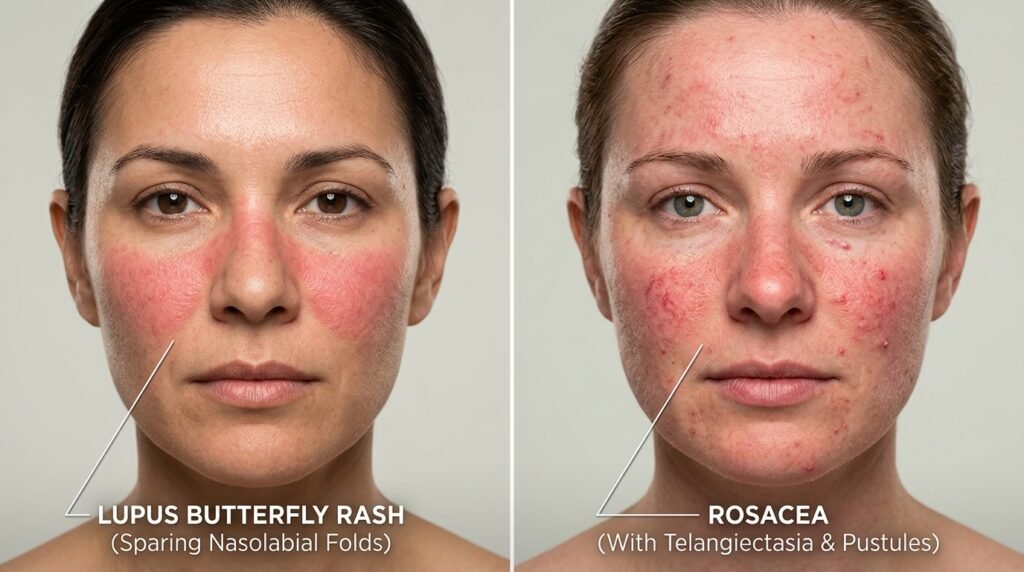
A lupus malar rash forms a distinct butterfly shape. The “wings” of the rash spread across both cheeks, while the “body” crosses the bridge of the nose.
According to Medical News Today [2024], a lupus rash may appear red or salmon-colored on lighter skin. On darker skin tones, it can look dark brown or dark purple.
One massive clue is that the lupus rash usually spares the nasolabial folds. Those are the deep smile lines running from your nose to the corners of your mouth. The skin there usually remains totally clear.
What does a rosacea rash look like?
Rosacea is much less precise than lupus. The redness is typically concentrated on the cheeks and nose, but it easily spreads.
You will often see rosacea creep up to the forehead or down to the chin. The redness looks more like a general flush or blush that won’t go away.
A major visual difference is what happens on top of the red skin. Rosacea frequently causes visible, broken blood vessels and small, pus-filled bumps that look exactly like acne breakouts.
What are the key visual differences in side-by-side lupus vs rosacea pictures?
If you place pictures of a lupus rash and rosacea side-by-side, a few things jump out.
First, look at the texture. The lupus rash might have a slightly raised edge on its outer border, or it might be completely flat. It does not typically have pimples.
Second, look at the spread. The rosacea picture will often show acne-like bumps (pustules) and redness that extends far beyond the classic butterfly shape.
What are the main differences between lupus and rosacea?
Beyond just looking at the skin, these two conditions behave very differently. Knowing how your body feels overall is a massive piece of the puzzle.
Let’s break down how the rashes feel, what triggers them, and what other symptoms they bring along.
How does the rash appearance differ in texture?
A lupus rash can be flat or slightly raised. Sometimes, the skin feels hard, rough, or scaly to the touch. It does not look like a breakout.
Rosacea, on the other hand, often looks and feels bumpy. According to Healthline [2024], the presence of pus-filled pimples (pustules) is a strong indicator of rosacea.
What triggers a flare-up for each condition?
Sun exposure is a massive trigger for a lupus malar rash. Just a few minutes in direct UV light can cause a painful flare-up for someone with lupus.
Rosacea has a much longer list of daily triggers. Things like hot temperatures, spicy foods, red wine, and emotional stress can cause the face to flush instantly.
What are the associated symptoms for lupus and rosacea?
This is where the conditions split completely. Because lupus is a systemic disease, a facial rash is rarely the only symptom.
Someone with lupus might also experience:
- Severe, crushing fatigue
- Joint pain and stiffness
- Unexplained fevers
- Thinning hair or hair loss
Rosacea symptoms stay localized to the head and face. Aside from facial flushing, people with rosacea often experience:
- A stinging or burning sensation on the skin
- Dry, swollen, or irritated eyes
- Thickening of the skin, especially around the nose
Which areas are commonly affected by these rashes?
As mentioned earlier, the lupus malar rash sits strictly on the cheeks and nose. Other types of lupus rashes (like discoid lupus) can appear on the neck, scalp, or arms.
Rosacea primarily affects the center of the face. However, it frequently spreads to the chin, forehead, ears, and occasionally the upper chest.
Why is lupus frequently mistaken for rosacea?
Misdiagnosis happens because, at first glance, a red face is just a red face.
Both conditions cause a prominent malar rash. If a doctor only looks at the redness and does not ask about fatigue or joint pain, they might assume it is a simple skin issue.
According to the Lupus Foundation of America, misdiagnosis is especially common in people with dark skin tones. This highlights the importance of seeing a specialist who understands diverse skin presentations and runs the proper medical tests.
How do doctors diagnose lupus vs rosacea?
You cannot diagnose either of these conditions with a simple Google image search.
Medical professionals use a combination of physical exams and lab tests to find the true cause of your facial redness.
How does a physical examination help?
A dermatologist will look closely at your skin under bright lights. They will check for those visible blood vessels and acne-like bumps that point to rosacea.
They will also ask detailed questions about when the rash appears, what makes it worse, and if it hurts or itches.
What blood tests are used for lupus?
Because there is no single test for lupus, doctors rely on a combination of blood work.
A rheumatologist will often order an Antinuclear Antibody (ANA) test. While a positive ANA test doesn’t guarantee you have lupus, almost all people with lupus test positive for it. They will also look for other autoimmune markers and signs of organ inflammation.
When is a dermatology evaluation and skin biopsy needed?
If the diagnosis is still unclear, a dermatologist might perform a skin biopsy.
They will numb a tiny area of your rash and remove a microscopic piece of skin. Under a microscope, lupus and rosacea look completely different, allowing the doctor to make a definitive diagnosis.
What are the treatment differences between lupus and rosacea?
Since the root causes are different, the treatments are entirely separate.
Choose rosacea treatments if your symptoms are limited to facial skin irritation. Choose lupus treatments if your rash is part of a broader autoimmune response.
What are the common lupus treatments?
Because lupus has no cure, treatment focuses on calming the immune system.
Doctors often prescribe antimalarial drugs like hydroxychloroquine to prevent disease progression. They may also use corticosteroids or immunosuppressants to manage severe flare-ups. Strict sun protection is also mandatory.
What are the common rosacea treatments?
Rosacea treatment targets the skin directly.
Dermatologists often prescribe topical creams containing antibiotics to reduce inflammation and clear up the acne-like bumps. Laser therapy is also highly effective at removing visible blood vessels. The most crucial step is identifying and avoiding your personal daily triggers.
When should you see a doctor about your rash?
Do not ignore a persistent facial rash.
You should book an appointment with a healthcare provider if your facial redness won’t go away, or if it starts spreading.
More importantly, seek medical advice immediately if your skin rash is accompanied by joint pain, extreme tiredness, fevers, or eye irritation. These are signs that something deeper than a standard skin irritation is happening in your body.
Frequently Asked Questions
Does lupus rash look like rosacea?
Yes, they can look very similar. Both can cause a red, butterfly-shaped rash across the cheeks and bridge of the nose. However, rosacea usually includes acne-like bumps and visible blood vessels, while a lupus rash is typically flat or scaly.
How can I tell if my rash is lupus or rosacea?
You can look for visual clues, like whether the rash crosses your smile lines (which lupus usually avoids). However, only a doctor can tell you for sure. They will run blood tests to check for lupus antibodies or examine your skin for specific rosacea markers.
Can you have both lupus and rosacea?
Yes, it is possible to have both conditions at the same time. Since one is an autoimmune disease and the other is a skin condition, they can overlap. This makes getting a professional medical evaluation incredibly important.
Does rosacea cause a butterfly rash?
Yes. While the butterfly (malar) rash is famous for being a sign of lupus, rosacea is actually the most common cause of this specific rash pattern.
Are lupus rashes always painful or itchy?
No. A lupus malar rash can sometimes feel itchy or painful, but many people report that the rash doesn’t physically hurt at all. It varies significantly from person to person.
Taking the Next Step for Your Skin Health
Figuring out the difference between lupus and rosacea pictures is a great first step.
You now know that rosacea brings bumps and visible blood vessels, while lupus brings a flat rash often paired with systemic symptoms like joint pain.
However, internet research can only take you so far. If you are struggling with a persistent facial rash, make an appointment with a dermatologist or a primary care doctor. Getting the right diagnosis early is the best way to get your symptoms under control and start feeling like yourself again.
Learn more about managing your lupus:
- Read about Lupus and Sjögren’s Syndrome
- Explore our Lupus Infusion Therapy: Complete Guide to IV Treatments
- Discover if Lupus is a Disability? Guide to Benefits
- Learn about Lupus and Menstruation