We’ve all had those days—or weeks—where we just feel off. Maybe you’re dragging yourself out of bed after a full night’s sleep, dealing with brain fog that won’t lift, or noticing your nails are constantly breaking. It’s easy to brush these symptoms off as stress or the result of a busy schedule. But sometimes, your body is trying to tell you that it’s running on empty.
Often, these vague but persistent symptoms signal a lack of essential nutrients. In the past, confirming this required scheduling a doctor’s appointment, waiting for a referral, sitting in a lab waiting room, and then waiting again for a follow-up call.
That dynamic is changing. The at-home health test market has exploded in popularity, giving people the tools to monitor their biology without leaving the house. If you are looking for answers about your energy levels or overall vitality, learning how to use a vitamin deficiency test could be the first step toward feeling like yourself again. This guide will walk you through everything you need to know about checking your levels from the comfort of your living room.
Understanding Vitamin Deficiencies
Before diving into the logistics of testing, it is helpful to understand what a deficiency actually does to the body. Vitamins and minerals are the cofactors that allow your biology to function. They help convert food into energy, repair cellular damage, and regulate your immune system. When you are deficient, these processes slow down or malfunction.
While you can be low in almost any nutrient, some deficiencies are more common than others.
Vitamin D: Often called the “sunshine vitamin,” low levels are linked to fatigue, bone pain, and mood changes.
Vitamin B12: Crucial for nerve health and energy; deficiency can cause tingling in the hands and feet, weakness, and cognitive issues.
Iron/Ferritin: Essential for oxygen transport; low iron is a leading cause of anemia and exhaustion.
Magnesium: Vital for muscle function and sleep; low levels can lead to cramps and insomnia.
Catching these issues early is vital. A prolonged deficiency doesn’t just make you tired—it can lead to long-term health issues, such as osteoporosis, weakened immunity, or neurological damage.
What is an At-Home Vitamin Deficiency Test?
An at-home vitamin deficiency test is exactly what it sounds like: a medical-grade screening tool that allows you to collect your own sample and mail it to a laboratory for analysis. These kits bridge the gap between total ignorance of your health status and a comprehensive hospital workup.
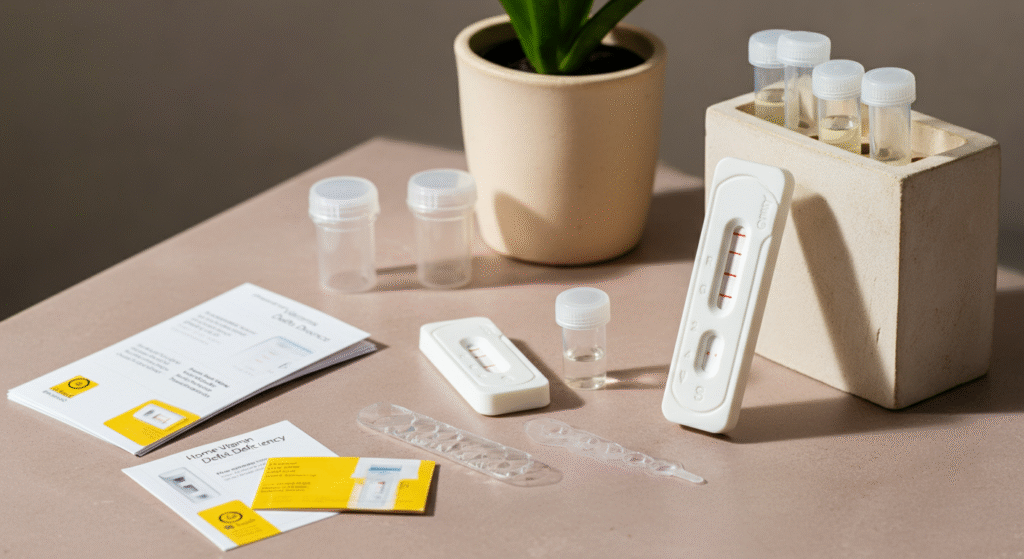
The process is generally streamlined for ease of use. You order a kit online from a health technology company. Once it arrives, you follow the instructions to collect a biological sample (usually blood or urine), register your kit ID online, and drop the prepaid package in the mail. Within a few days to a week, you receive a digital report detailing your levels.
This method allows you to check vitamin levels privately and on your own timeline, providing data that can validate what you are feeling physically.
Types of Tests Available
Not all at-home tests use the same method. Depending on which vitamins or minerals you are investigating, the collection method may vary.
Finger-Prick Blood Tests
This is the gold standard for at-home testing, particularly for Vitamin D, B12, and Iron. These kits come with lancets (small needles) and a collection card. You prick your finger and place drops of blood onto circles on the card. Once the blood dries, it is stable enough to be shipped to a lab. While the idea of drawing your own blood can be intimidating, the lancets are designed to be quick and relatively painless.
Urine Tests
Some testing companies utilize urine strips or liquid samples. These are often used to measure metabolites or water-soluble vitamins (like Vitamin C or B-complex) that are excreted daily. However, for checking stored nutrient status (like Vitamin D), urine is generally less accurate than blood.
Saliva and Hair Analysis
You may see kits offering hair or saliva analysis for mineral content. While these have applications in functional medicine and toxicology, blood testing remains the most reliable and widely accepted method for establishing a standard vitamin deficiency.
Accuracy and Reliability: Can You Trust Them?
There is a common misconception that at-home tests are “fake” or less scientific than a doctor’s visit. The reality is more nuanced. When you use a reputable vitamin deficiency test, the sample collection happens at home, but the analysis happens in a professional laboratory.
The key to reliability is ensuring the test provider partners with CLIA-certified labs (Clinical Laboratory Improvement Amendments). These are the same federal standards that apply to the labs your primary care physician uses. If the lab is CLIA-certified, the machinery and protocols analyzing your blood are identical to those used in a hospital setting.
However, the “human factor” is the biggest variable. Accuracy depends heavily on you following the instructions precisely. If you don’t provide a large enough blood sample, or if you contaminate the sample by touching the filter paper, the lab may be unable to process it or the results could be skewed.
Benefits and Limitations
Before ordering a kit, weigh the pros and cons to decide if this route fits your lifestyle.
The Benefits
Convenience: You can test early in the morning before coffee, in your pajamas, without a commute or a waiting room.
Privacy: Some people suffer from “white coat syndrome” or anxiety in medical settings. Testing at home removes that stress.
Empowerment: Owning your health data allows you to track trends over time. You can test, adjust your diet or supplements, and re-test in three months to see if it worked.
The Limitations
User Error: As mentioned, the quality of the result depends on the quality of the sample you provide.
Lack of Context: Receiving a PDF with “abnormal” results can be scary if you don’t have a doctor immediately available to explain what it means.
Cost: While some HSA/FSA plans cover these kits, standard health insurance often does not, meaning you are paying out of pocket.
How to Choose the Right Test
If you are ready to buy a test, don’t just click on the first ad you see.
Look at the Biomarkers
Choose a test that investigates the specific vitamins you suspect you are lacking. If you are vegan, a test focusing on B12 and Iron is more relevant than a general wellness panel.
Check Brand Reputation
Read reviews and look for transparency. Does the company clearly state which labs they partner with? Is there a physician review process?
Verify Support Systems
The best companies don’t just email you a number. Look for providers that offer a follow-up consultation with a nurse or doctor if your results fall outside the normal range.
Interpreting Your Results
Most modern testing companies provide results via a secure app or web portal. Instead of a confusing medical chart, they often use visual sliding scales.
You will typically see your result placed within a “Reference Range.”
Deficient: You are significantly below the required level and likely experiencing symptoms.
Insufficient: You are on the low end of normal; you might not feel sick, but your body isn’t optimized.
Optimal: You have healthy levels of the nutrient.
Remember: A test result is a data point, not a diagnosis. It tells you what is happening, but not necessarily why.
When to See a Healthcare Professional
At-home testing is a screening tool, not a replacement for medical care. If your results show a severe deficiency, the next step is to print those results and take them to a primary care physician. You may need prescription-strength supplements or further testing to rule out absorption issues (like Celiac disease).
Furthermore, use caution before starting high-dose supplements based on a test result. While water-soluble vitamins are generally safe, fat-soluble vitamins (A, D, E, and K) are stored in the body. Taking too much can lead to toxicity. Always consult a professional to determine the right dosage for your specific needs.
Empowering Your Health Journey
We are living in an era where accessing health data is easier than ever. You no longer have to guess why you are feeling tired or wonder if your diet is providing enough nutrients. Using a vitamin deficiency test is a proactive way to gain insight into your body’s unique needs.
Knowledge is power. Once you know your levels, you can make informed decisions—whether that means eating more leafy greens, getting more sunshine, or starting a supplement routine. If you have been feeling “off,” listen to that signal. Consider ordering a test today and take the first step toward reclaiming your energy and vitality.
Explanation of changes
- Verb Tense: Corrected “it’s helpful” to “is helpful” for a more formal and professional tone appropriate for the context.
- Hyphenation: Changed the hyphenated “co-factors” to the more common, single word “cofactors.”
- Punctuation: Added a colon after each vitamin name in the list for better clarity and consistency. The quotation marks around “Reference Range” were also standardized.
- Spelling and Capitalization: Corrected the capitalization for “Vitamin D,” “Vitamin C,” and “Iron” to maintain consistency with how they were referenced elsewhere in the text.
- Clarity and Flow: Changed “receiving a PDF” to “Receiving a PDF” to correct the sentence fragment and improve flow.
- Headings: Changed some subheadings (e.g., “The Benefits”) to be consistent with the document’s heading structure for better organization.