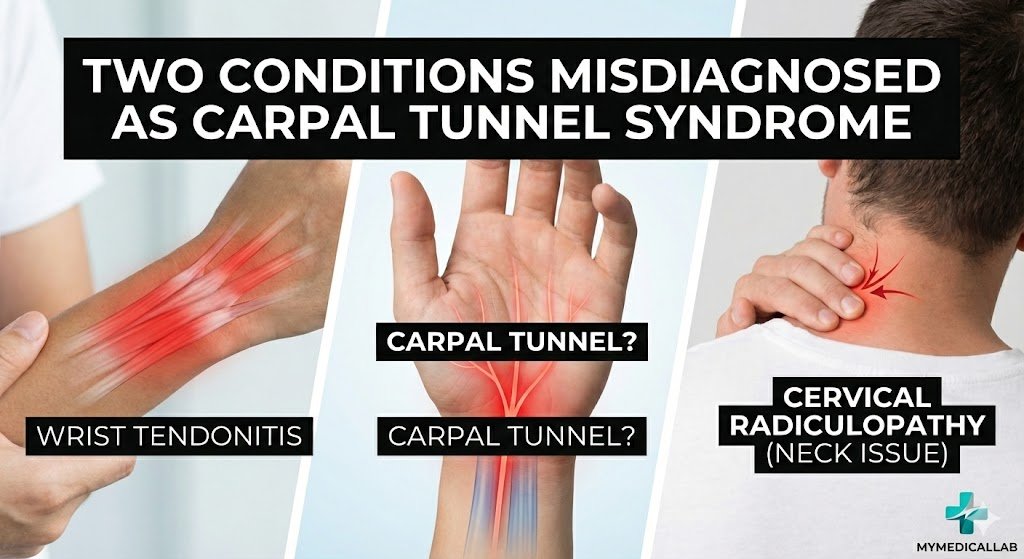
Carpal Tunnel Syndrome has become the default diagnosis for nearly any type of hand pain or numbness. But if your treatment isn’t working after weeks or even months, there’s a good chance your doctor got the diagnosis wrong.
Treating the wrong condition means enduring needless pain, wasting money on ineffective gear, and potentially undergoing unnecessary surgery. The median nerve—the main nerve causing your symptoms—runs all the way from your neck, down your arm, and into your hand.
If that nerve gets pinched anywhere along that path, your fingers will go numb. Doctors often assume the compression is at the wrist (carpal tunnel syndrome), but the real culprit could be somewhere else entirely.
In this guide, we’ll break down the two main conditions that perfectly mimic carpal tunnel syndrome, show you exactly how their symptoms differ, and explain what recovery strategies actually work for each one.
Why Is Carpal Tunnel Misdiagnosed So Often?
To understand why misdiagnosis happens, you need to know a bit about anatomy. The median nerve originates from nerve roots in your neck (cervical spine), travels down through your shoulder and forearm, passes through the carpal tunnel at your wrist, and finally branches out into your thumb, index, middle, and half of your ring finger.
Here’s the trap: if that nerve gets compressed or irritated at any point along this pathway, you’ll experience numbness, tingling, or weakness in your hand.
Because carpal tunnel syndrome is so common and well-known, many healthcare providers automatically assume the problem is at the wrist. They completely miss the possibility that the nerve might be getting pinched in your forearm or neck.
Without proper testing, it’s easy to mistake other nerve compression syndromes for carpal tunnel syndrome. That’s why understanding the key differences is so important.
Condition 1: Wrist Flexor Tendonitis (The Local Mimic)
What It Is
Wrist flexor tendonitis occurs when the tendons connecting your forearm muscles to your fingers become inflamed and swollen. This typically happens from repetitive motions like typing, gaming, assembly line work, or gripping tools for extended periods.
How It Mimics Carpal Tunnel Syndrome
When these tendons swell up, they take up more space in the already-tight carpal tunnel. This creates pressure on the median nerve, leading to weakness and pain in your hand—symptoms that look almost identical to carpal tunnel syndrome.
How to Tell the Difference
The “Pinky” Rule: According to the American Academy of Orthopaedic Surgeons, carpal tunnel syndrome affects the thumb, index, middle, and ring fingers—but never the pinky. The median nerve doesn’t supply sensation to your little finger. If your pinky is numb or hurting, you don’t have carpal tunnel syndrome.
The Type of Pain: Tendonitis produces a dull, stiff ache that gets worse when you move your fingers or flex your wrist. Carpal tunnel syndrome, on the other hand, causes burning, electric shock-like sensations, or “pins and needles,” especially at night when your wrist is bent during sleep.
The Tinel Test: During a physical exam, doctors will tap along the median nerve at your wrist crease. If this reproduces tingling or electric shocks shooting into your fingers, it suggests nerve compression. However, this test alone can’t distinguish between tendonitis-induced compression and true carpal tunnel syndrome—you’ll need additional diagnostic testing.
Condition 2: Cervical Radiculopathy (The Distant Mimic)
What It Is
Cervical radiculopathy is a pinched nerve in your neck, usually caused by a herniated (bulging) disk, bone spurs from arthritis, or poor posture that narrows the space where nerve roots exit your spinal column.
How It Mimics Carpal Tunnel Syndrome
Because the nerves in your hand originate from nerve roots in your cervical spine, compression at the neck sends pain, tingling, and numbness all the way down into your fingers. Your brain can’t always tell where along the nerve pathway the problem is occurring, so it feels like the issue is in your hand.
How to Tell the Difference
The Neck Test (Spurling Test): If turning your head, looking over your shoulder, or tilting your head to one side reproduces or worsens the tingling in your hand, the problem is likely in your neck. During a Spurling test, a doctor gently presses down on the top of your head while your neck is tilted. If this causes radiating pain or tingling down your arm, it indicates cervical radiculopathy.
Radiating Pain Pattern: Cervical radiculopathy typically causes pain that shoots from your neck down through your shoulder and into your arm. The pain follows the path of the affected nerve root. Carpal tunnel syndrome, by contrast, stays localized to your hand and wrist, with occasional discomfort traveling up the forearm but not usually extending to the shoulder or neck.
Braces Don’t Work: Here’s a clear red flag—if you’ve been wearing a wrist splint religiously for weeks and it’s doing absolutely nothing, the nerve compression is probably not happening at your wrist. A wrist brace can’t address a pinched nerve in your neck.
Honorable Mentions: Other Common Mimics
Rheumatoid Arthritis (RA)
Rheumatoid arthritis is an autoimmune disease that causes severe joint inflammation and swelling. When the joints in your wrist become inflamed, they can compress the median nerve. A key difference: RA usually affects both hands symmetrically and features pronounced morning stiffness that improves throughout the day. If you’re waking up with stiff, swollen hands on both sides, it’s worth getting tested for RA.
Pronator Teres Syndrome
This condition happens when the median nerve gets compressed by the pronator teres muscle in your forearm—not at the wrist. Pronator teres syndrome causes similar numbness and tingling but tends to produce more forearm pain.
Unlike carpal tunnel syndrome, symptoms may worsen with repetitive pronation (turning your palm down) rather than wrist flexion.
How to Get the Right Diagnosis
If your symptoms aren’t improving with standard carpal tunnel treatment, ask your doctor about these diagnostic tests:
Electromyography (EMG) and Nerve Conduction Studies: These tests measure how well electrical signals travel through your nerves and muscles. They can pinpoint exactly where the median nerve is being compressed—whether it’s at the wrist, forearm, or neck. This is considered the gold standard for diagnosing nerve compression syndromes.
Diagnostic Ultrasound: High-resolution ultrasound imaging allows doctors to visualize the median nerve at the wrist in real time. They can measure the nerve’s cross-sectional area and look for signs of compression or swelling. This non-invasive test is becoming more common as an alternative or complement to EMG studies.
MRI of the Cervical Spine: If cervical radiculopathy is suspected, an MRI can reveal herniated disks, bone spurs, or other structural problems in your neck that might be pinching nerve roots.
The Right Recovery Gear for the Right Condition
Using the wrong recovery tools can actually make your condition worse. Here’s what works for each diagnosis:
If You Have Wrist Flexor Tendonitis
- Daytime Compression Sleeves: These improve blood flow and reduce inflammation without restricting movement during daily activities.
- Ergonomic Vertical Mice: A vertical mouse keeps your forearm in a neutral position, eliminating the repetitive twisting motion that aggravates tendonitis.
- Rest and Ice: Give your tendons time to heal by taking frequent breaks and applying ice after repetitive tasks.
If You Have Cervical Radiculopathy
- Cervical Traction Pillows: These specialized pillows gently stretch and decompress your neck while you sleep, relieving pressure on pinched nerve roots.
- Posture Correctors: Poor posture is a leading cause of cervical radiculopathy. A posture corrector helps retrain your shoulders and neck into proper alignment.
- Ergonomic Monitor Stands: Raising your computer screen to eye level prevents the forward head posture that compresses cervical nerve roots.
If You Actually Have Carpal Tunnel Syndrome
- Open-Palm Night Splints: These keep your wrist in a neutral position while you sleep, preventing the wrist flexion that increases pressure in the carpal tunnel.
- Ergonomic Keyboard Trays: Position your keyboard so your wrists stay straight and level with your forearms during typing.
Frequently Asked Questions
Can you have tendonitis and carpal tunnel at the same time?
Yes. Both conditions are caused by repetitive stress and overuse. The swollen tendons from tendonitis can actually trigger or worsen carpal tunnel syndrome by reducing the available space in the carpal tunnel.
Will a carpal tunnel brace make tendonitis worse?
It can. A rigid carpal tunnel brace forces your tendons to work against the hard splint during movement, which may increase inflammation and delay healing. If you have tendonitis, use a flexible compression sleeve instead.
How do doctors test for a pinched nerve in the neck?
Doctors use a combination of physical exams (like the Spurling test) and imaging. The Spurling test involves gently pressing down on your head while your neck is tilted—if this reproduces shooting pain or tingling down your arm, cervical radiculopathy is likely. An MRI of your cervical spine provides detailed images of herniated disks or bone spurs compressing nerve roots.
Conclusion
If you’ve been treating “carpal tunnel syndrome” for weeks with no improvement, it’s time to advocate for yourself. Ask your doctor about nerve conduction studies, consider getting a second opinion, or request imaging of your neck if your symptoms point to cervical radiculopathy.
The right diagnosis leads to the right treatment—and that means finally getting relief from the pain, numbness, and frustration that have been holding you back.
Sources
- National Institutes of Health (NIH): Differentiating between cervical radiculopathy and carpal tunnel.
- American Academy of Orthopaedic Surgeons (AAOS): Wrist tendonitis symptoms vs median nerve compression.