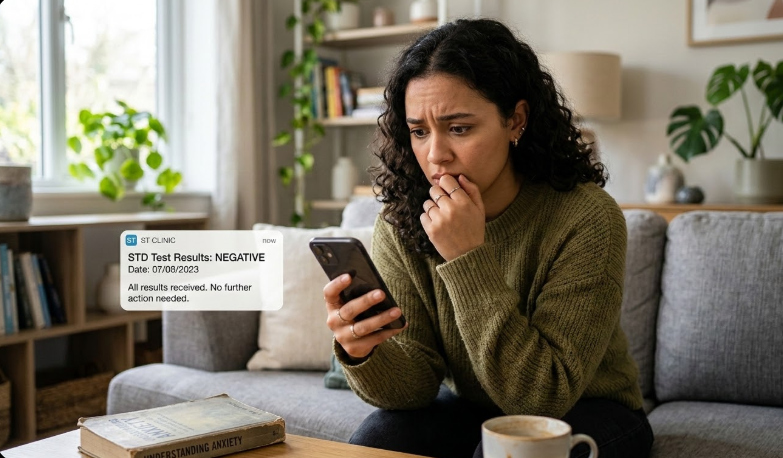
Getting a negative STD test result should feel like a massive relief. You wait for the call or the email, bracing yourself for bad news. Then, the clinic tells you that everything looks clear.
But what if you still feel physical symptoms? Or what if you simply cannot stop panicking about a recent sexual encounter?
If you are reading this, your worry is completely valid. It is normal to feel confused or frightened when your test results do not match how your body feels. You know your body best. If something feels off, you should pay attention to it.
There are three highly common, easily fixable medical reasons why you might still be experiencing issues. There is also one powerful psychological reason. Let us walk through exactly what might be happening and how you can fix it.
You Tested Too Early (The “Window Period”)
Many people rush to the clinic the morning after a risky encounter. This is a very common mistake. Medical tests do not look for the sexual encounter itself. They look for your body’s reaction to an infection, like antibodies, or the multiplying bacteria.
This biological process takes time. If you tested just two or three days after exposure, the test will almost always be negative. This is true even if you actually caught something. Doctors call this the “window period.”
To get an accurate result, you must wait for the window period to pass. For infections like Chlamydia and Gonorrhea, you should wait at least one to two weeks before testing. For conclusive HIV results, the window period can be up to three months. If you tested too soon, you will need to test again.
You Were Tested for the “Wrong” Infections
When you ask a doctor for a “standard STD check,” you might assume they are checking for everything. This is a major myth. Most standard clinic panels only look for four things: Chlamydia, Gonorrhea, Syphilis, and HIV.
The problem is that many other hidden infections cause the exact same burning, itching, or discharge. These infections are rarely tested for unless you specifically ask for them.
Here are a few common culprits that standard tests miss:
- Ureaplasma and Mycoplasma: These are common bacterial infections that cause urinary pain and discharge.
- Trichomoniasis: This is a very common parasite that causes irritation and unusual discharge.
- Herpes (HSV): Clinics often skip this on standard blood tests unless you have an active sore to swab.
If your standard test was negative but you still have symptoms, you might simply have a different infection.
It is an Infection, Just Not an STD
The genital area is highly sensitive. Many common, non-sexual infections mimic STD symptoms perfectly. You might be suffering from a basic bacterial issue that has nothing to do with sex.
For women, Yeast Infections and Bacterial Vaginosis (BV) are incredibly common. These cause intense itching, odor, and discharge. However, they are caused by simple pH imbalances in the body, not a sexually transmitted germ.
For both men and women, Urinary Tract Infections (UTIs) are another frequent issue. A simple UTI will cause severe burning during urination and pelvic pain. This can easily trick you into thinking you have caught an STD. A quick trip to the doctor for a round of standard antibiotics will usually clear these up.
The Mind-Body Connection (Health Anxiety)
Sometimes, the issue is not an infection at all. A sexual health scare takes a massive mental toll. When you are hyper-focused on your body out of fear, your brain amplifies normal sensations.
Severe anxiety can literally cause physical symptoms. This is called a psychosomatic response. Extreme stress can lead to frequent urination, heavy sweating, and phantom tingling or itching in the pelvic area.
If a doctor has cleared you completely and ruled out other infections, your nervous system might just be on high alert. Your body might just need time to reset and relax.
Your Next Step: Get Complete Peace of Mind at Home
If you tested too early, or if you only got a basic four-panel test at the clinic, your journey is not over. You need a more comprehensive follow-up to close the book on this anxiety. You deserve to know exactly what is happening in your body.
Advanced, 10-panel or 14-panel at-home STD test kits offer a perfect solution. These kits check for the obscure infections like Ureaplasma and Mycoplasma that standard clinicians often miss. They allow you to test for a much wider range of issues without making another awkward trip to the waiting room.
Stop guessing and stop worrying. Order a comprehensive, FDA-approved at-home test kit today to check for all 14 common infections from the total privacy of your home. Taking control of your health is the fastest way to find true peace of mind.
Frequently Asked Questions (FAQ)
How common is a false negative STD test?
False negatives are very rare if you test outside the window period. Modern lab tests are incredibly accurate. False negatives usually only happen if you test too soon after exposure.
Can an STD hide in your body and not show up on a blood test?
No. Once the window period has passed, your body’s immune response or the bacteria itself will be detectable by clinical lab equipment. Even if an infection is silent or without symptoms, a proper test will find it.