You reach for your coffee cup. A sharp, stabbing pain shoots up the side of your wrist. You try to pick up your phone. The pain gets worse. You attempt to turn a doorknob, lift your baby, or even button your shirt—and every single movement feels like grinding glass inside your thumb joint.
If this sounds familiar, you might be dealing with De Quervain’s tenosynovitis (also called De Quervain’s syndrome). New parents sometimes call it “Mommy’s Thumb” or “Gamer’s Thumb,” but the official name doesn’t matter. What matters is the pain is real, and it makes everyday life miserable.
The good news? The right medical devices can help you recover faster, reduce pain, and get back to normal activities without needing surgery.
What’s Actually Happening Inside Your Wrist
Your thumb moves thanks to two tendons: the abductor pollicis longus (APL) and the extensor pollicis brevis (EPB). These tendons slide through a narrow tunnel called a tendon sheath, kind of like a rope running through a tight pulley.
When you overuse your thumb—from texting, gaming, lifting heavy objects, or caring for an infant—the sheath gets inflamed and swollen. Now the tendons can’t slide smoothly anymore. Every thumb movement creates painful friction. The swelling squeezes the tendons even tighter, which causes more pain, which leads to more swelling. It’s a frustrating cycle.
According to the Cleveland Clinic, De Quervain’s tenosynovitis affects about 1% of people in the United States each year. Women over 40 are more likely to develop it, especially if they work with their hands, play sports like tennis or racquetball, or care for young children.
How Do You Know If You Have It?
Doctors use a simple physical test called the Finkelstein test. Here’s how it works:
- Tuck your thumb into your palm
- Wrap your fingers around your thumb to make a fist
- Bend your wrist down toward your pinky finger
If you feel a sharp, intense pain shooting up the thumb side of your wrist, that’s a strong sign you have De Quervain’s syndrome.
However, if your symptoms lean more toward numbness, tingling in your middle fingers, or waking up with a “dead” hand, you are likely dealing with median nerve compression. Head over to our breakdown of the
best at-home recovery gear for carpal tunnel syndrome to explore those specific tools.
Other common symptoms include:
- Swelling near the base of your thumb
- A snapping or popping feeling when you move your thumb
- Numbness or tingling in your thumb or wrist
- Pain that gets worse when gripping, pinching, or twisting your wrist
The Only Way to Heal: Rest Your Thumb
Here’s the hard truth: your thumb tendons will not heal if you keep using them. You need to completely immobilize (freeze) your thumb and wrist so the swelling can go down and the irritated tissues can recover.
That’s where medical devices come in. From simple at-home braces to advanced clinical treatments, these tools do one thing really well—they stop the grinding, reduce inflammation, and give your tendons the rest they desperately need.
Best At-Home Recovery Gear for De Quervain’s Syndrome
1. Thumb Spica Splints (The First Line of Defense)
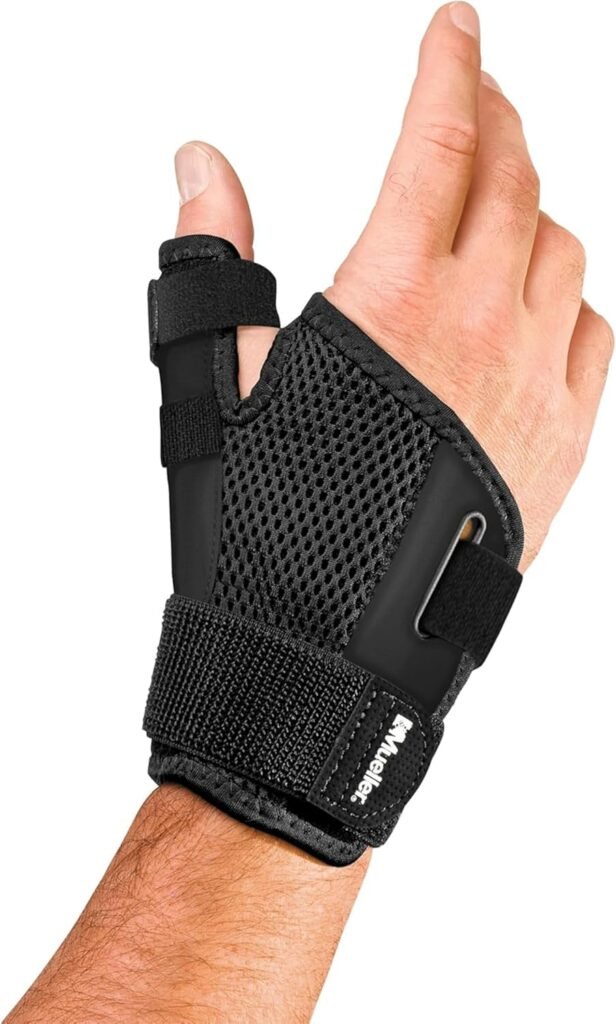
What it feels like: A firm, supportive hug around your wrist and the lower half of your thumb. Your other fingers stay free to move.
Why you need it: A regular wrist brace won’t cut it. You need a thumb spica splint. These devices have a rigid aluminum stay (a thin metal rod) built into the fabric. The stay completely freezes your thumb joint in a neutral, resting position. This stops your tendons from sliding through the inflamed sheath.
According to the American Academy of Orthopaedic Surgeons (AAOS), wearing a thumb spica splint is one of the most effective conservative treatments for De Quervain’s. The splint keeps your wrist straight and your thumb still in a comfortable position, especially when worn at night.
Types to consider:
- Daytime splints: Lightweight, breathable neoprene models with adjustable Velcro straps. You can wear these while working at a computer or doing light household tasks.
- Night splints: Heavily padded, rigid splints with extra support. Many people accidentally bend their wrists or tuck their thumbs under their bodies while sleeping. A night splint prevents this.
Pro tip: Your doctor or physical therapist will likely recommend wearing the splint for several weeks, removing it only for hygiene (showering). The more consistently you wear it, the faster you’ll heal.
2. Cold Therapy Wrist Wraps
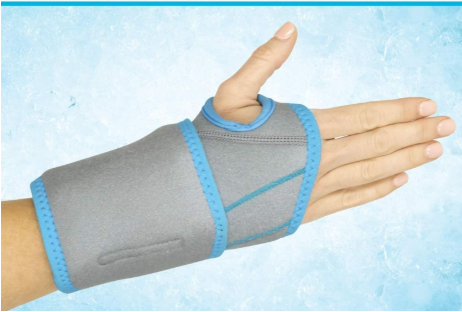
What it feels like: Deep, numbing relief directly over the swollen base of your thumb.
Why you need it: Ice shrinks swollen tissues and numbs pain signals. The Cleveland Clinic recommends icing your wrist for 20 minutes at a time, several times a day.
But here’s the problem with regular ice packs: they slide off. They melt. You have to sit still and hold them in place, which is frustrating when you’re trying to get through your day.
Better solution: Cold therapy wrist wraps. These are gel packs designed to wrap snugly around your thumb and wrist with adjustable straps. You can freeze the pack, strap it on, and keep moving (carefully) while the cold does its job.
Look for wraps that:
- Cover the radial side of your wrist (thumb side)
- Have adjustable compression straps
- Can be heated or frozen (some people prefer heat after the initial inflammation goes down)
3. Ergonomic Office and Gaming Devices
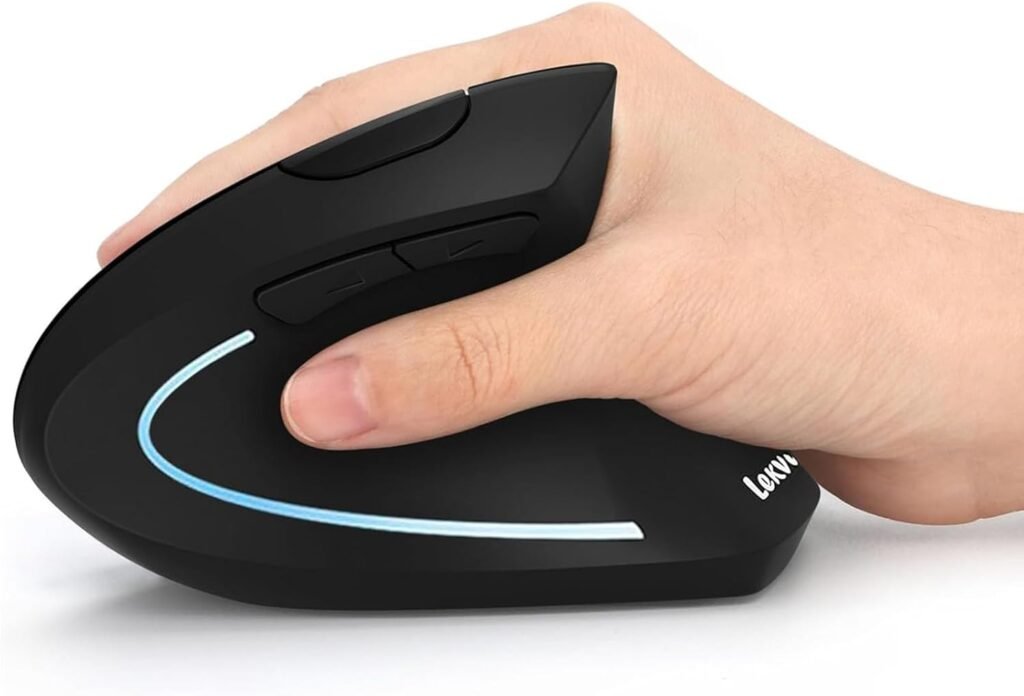
What it feels like: A more natural, relaxed handshake position for your arm and wrist.
Why you need it: Recovery isn’t just about treating the pain. You also need to prevent it from coming back.
Standard computer mice and keyboards force your wrist into awkward, twisted positions. Every click, every keystroke puts tiny amounts of stress on your thumb tendons. Over weeks and months, that repetitive stress triggers inflammation.
Smart swaps:
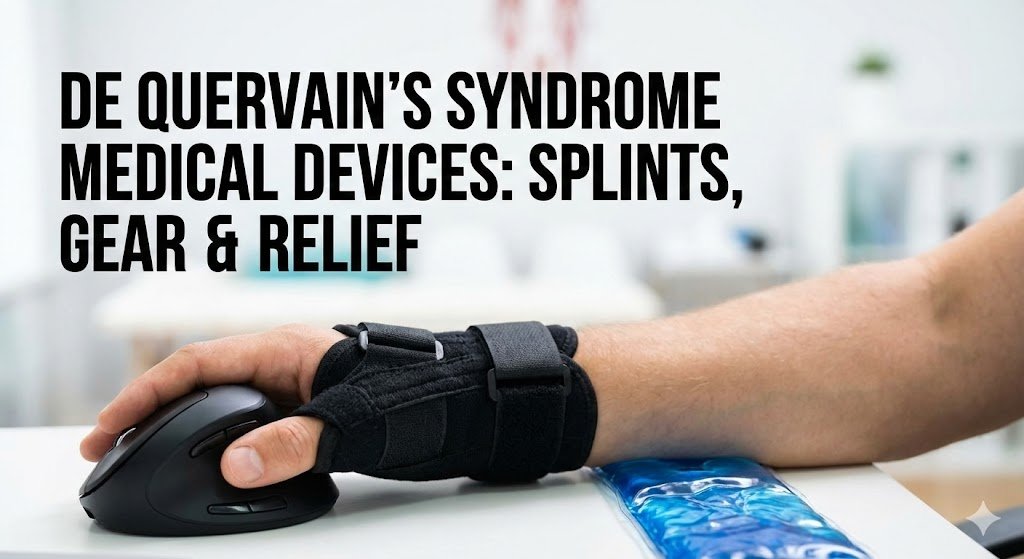
- Vertical ergonomic mice: These mice rotate your hand 90 degrees, so you’re holding it like shaking someone’s hand. This neutral position takes pressure off your thumb tendons.
- Split keyboards: These keyboards angle each half to match the natural position of your arms, reducing wrist twisting.
- Wrist rests: Cushioned supports that keep your wrists elevated and straight while typing.
Pro tip: If you’re a gamer, consider switching to a controller with larger grips or remapping buttons so you don’t have to constantly press with your thumb.
Advanced Clinical Medical Devices Used by Professionals
1. High-Intensity Laser Therapy (HILT) and Ultrasound
What it is: Physical therapists and sports medicine doctors use specialized machines that deliver light energy (laser) or high-frequency sound waves (ultrasound) deep into your wrist tissues.
How it works: These devices don’t heat your skin. Instead, they stimulate blood flow and cellular repair at a microscopic level. More blood flow means more oxygen and nutrients reach the damaged tendons, which speeds up healing.
The science: A 2023 study published in the Medeni Medical Journal tested high-intensity laser therapy on 64 patients with De Quervain’s. All patients wore thumb spica splints. Half received 15 real HILT sessions over five weeks. The other half received fake (sham) laser treatments.
The results were impressive:
- Pain scores dropped significantly more in the HILT group
- Grip strength improved dramatically in the HILT group
- Both groups improved overall, but the laser group got better faster and felt stronger
The study concluded that HILT is a safe, non-invasive way to significantly reduce pain and increase grip strength in the short term.
Where to get it: You’ll need a prescription from your doctor. Physical therapy clinics, sports medicine centers, and some orthopedic offices offer HILT.
2. Iontophoresis Machines
What it is: A device that uses a mild electrical current to push liquid anti-inflammatory medication through your skin and directly into the swollen tendon sheath.
How it works: Your doctor or physical therapist applies a medicated gel (usually dexamethasone, a powerful anti-inflammatory) to your wrist. They place a small electrode pad over the gel and turn on the machine. The electrical current drives the medication molecules deep into the tissues without using a needle.
Why it helps: Oral anti-inflammatory pills (like ibuprofen) travel through your entire bloodstream. Only a small amount actually reaches the inflamed tendons in your thumb. Iontophoresis delivers medication right where you need it, with fewer side effects.
Where to get it: Physical therapy clinics and some urgent care centers offer iontophoresis treatments.
3. Ultrasound-Guided Steroid Injections
What it is: Your doctor uses a real-time ultrasound imaging screen to look inside your wrist while injecting corticosteroid medication directly into the swollen tendon tunnel.
How it works: Corticosteroids are powerful anti-inflammatory drugs. When injected precisely into the tendon sheath, they reduce swelling fast and provide significant pain relief.
Here’s the impressive part: According to the AAOS, one or two corticosteroid injections relieve De Quervain’s symptoms in 50% to 80% of patients. That’s a huge success rate.
Why ultrasound guidance matters: Without imaging, doctors have to rely on feel and experience to guide the needle. Ultrasound lets them see exactly where the needle tip is, ensuring the medication goes into the right spot. Studies show ultrasound-guided injections are more effective and cause fewer complications than blind injections.
Where to get it: Orthopedic surgeons, sports medicine doctors, and some primary care physicians perform these injections in their offices.
Should I Wear a Thumb Splint to Bed?
Yes. Absolutely.
Many people unconsciously bend their wrists or tuck their thumbs under their bodies while sleeping. Every time you do this, your inflamed tendons grind against the swollen sheath. You wake up with more pain than you had the night before.
A rigid night splint prevents this. It keeps your thumb and wrist in a perfectly neutral, resting position for eight hours straight. According to the AAOS, wearing a splint at night is especially important for healing.
Can Typing Cause De Quervain’s Tenosynovitis?
Yes. Repetitive thumb and wrist movements—typing, using a computer mouse, gaming, scrolling on a smartphone, texting—put constant stress on the APL and EPB tendons.
Over time, this repetitive stress causes microtrauma (tiny tears) in the tendon sheath. Your body responds by sending inflammatory cells to repair the damage. But if you keep doing the same repetitive motion every day, the inflammation never goes away. The sheath gets thicker and tighter. The tendons get more irritated. And eventually, you end up with full-blown De Quervain’s syndrome.
Frequently Asked Questions
How long does it take to recover from De Quervain’s syndrome?
Most people recover in a few weeks with splinting, rest, and ice. If you need a steroid injection, you might feel relief within a few days. If conservative treatments don’t work after several weeks, your doctor may recommend surgery.
Can I still work if I have De Quervain’s tenosynovitis?
It depends on your job. If you work at a desk, you can usually continue working while wearing a thumb splint and using ergonomic devices. If your job requires heavy lifting, gripping tools, or repetitive hand motions, you may need modified duties or temporary leave while you heal.
Will De Quervain’s syndrome come back?
It can, especially if you return to the same activities that caused it in the first place. Prevention is key. Use ergonomic tools, take frequent breaks, and listen to your body. If you start feeling pain again, rest immediately and wear your splint.
Do I need surgery for De Quervain’s syndrome?
Most people don’t. The AAOS reports that 50% to 80% of patients improve with nonsurgical treatments like splinting, anti-inflammatory medication, and injections. Surgery is usually reserved for patients who don’t respond to conservative care after several months.
The Bottom Line: Rest Is the Only Way to Heal
De Quervain’s syndrome hurts. It interferes with work, hobbies, and basic daily activities. But with the right medical devices—thumb spica splints, cold therapy wraps, ergonomic tools, and advanced clinical treatments—you can stop the pain, reduce inflammation, and give your tendons the rest they need to heal.
Start with a good thumb spica splint and ice therapy. If you’re not improving after a few weeks, talk to your doctor about steroid injections or physical therapy with laser or ultrasound treatments.
And remember: prevention is just as important as treatment. Invest in ergonomic office equipment, take regular breaks, and pay attention to early warning signs. Your thumbs work hard for you every single day. Give them the support they deserve.
Sources
- Cleveland Clinic. “De Quervain’s Tenosynovitis: Symptoms and Treatment.” Last updated June 14, 2023.
- American Academy of Orthopaedic Surgeons (AAOS). “De Quervain’s Tendinosis.”
- Dundar Ahi E, Sirzai H. “Short-term Effectiveness of High-intensity Laser Therapy in De Quervain Tenosynovitis: A Prospective, Randomized, Controlled Study.” Medeni Med J. 2023 Mar 27;38(1):24–31.