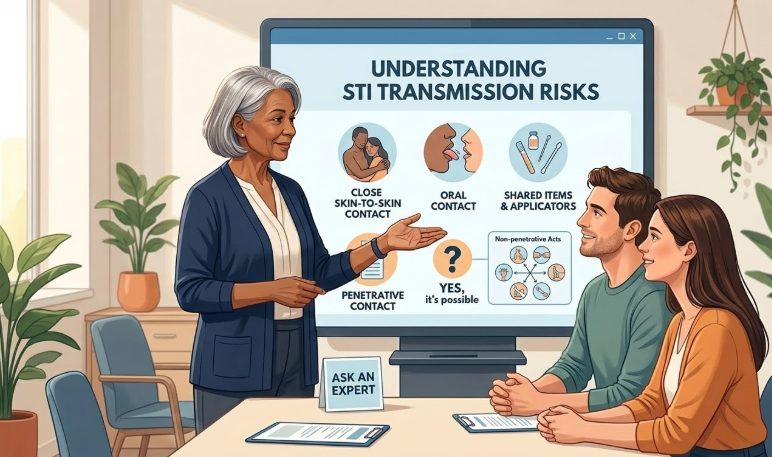
Yes, absolutely. You do not need to have penetrative intercourse (vaginal or anal) to contract a Sexually Transmitted Disease (STD) or Infection (STI).
It is completely normal to feel confused about how these infections spread. The term “sexually transmitted” is actually a bit misleading. It makes people think that only full intercourse carries a risk, leaving many unaware of other common transmission methods.
We are here to clear up the confusion. Understanding how your body works helps you make empowered, safe choices for your health.
How STDs Actually Spread (Beyond Intercourse)
Infections do not care about the technical definition of “intercourse.” They only need a suitable pathway to enter the human body.
These pathways generally fall into two main categories:
- Fluid Transmission: This happens when infected bodily fluids, such as semen or vaginal fluids, touch a mucous membrane. Your mucous membranes include the mouth, throat, urethra, and vagina.
- Skin-to-Skin Transmission: This occurs when an infection lives directly on the skin. It easily spreads through simple friction or close touch.
Skin-to-Skin Contact (The “Heavy Petting” Risk)
Certain infections spread simply by rubbing the genitals together. This happens even if no penetration occurs and no fluids are exchanged between partners.
- Herpes (HSV): The herpes virus sheds on the skin. If a partner has a cold sore on their mouth or a sore on their genitals, rubbing against it can spread the virus.
- HPV (Genital Warts): The Human Papillomavirus is extremely common. It spreads through close, friction-based skin contact in the pelvic area.
- Syphilis: Syphilis causes firm, round sores that are highly contagious to the touch.
Oral Sex (A Highly Common Route)
There is a massive misconception that oral sex is “safe sex” when it comes to infections. Many people believe they are fully protected if they avoid penetrative intercourse.
In reality, bacteria like Chlamydia, Gonorrhea, and Syphilis can easily infect the throat. This happens if a person gives oral sex to an infected partner.
Furthermore, throat infections are often completely silent. They rarely cause a noticeable sore throat, which is exactly why they go unnoticed and untreated for so long.
Sharing Sex Toys
Bacteria and viruses can survive on the surface of sex toys for a short period of time.
If a toy is used on one partner and immediately used on another, it creates a direct bridge for bacteria. You can easily pass infections this way unless the toy is thoroughly washed or covered with a fresh condom before sharing.
Can a Virgin Get an STD?
This is a very common question, and the answer comes down to how we define virginity. Society usually defines “virginity” as meaning someone has not had penetrative vaginal sex.
However, viruses and bacteria follow biology, not social definitions. Because STDs spread through oral contact, manual stimulation (like fingering with infected fluids), and skin-to-skin rubbing, the risk remains. Someone who identifies as a virgin can absolutely still catch an STD.
Busting Myths: What Won’t Give You an STD
When you start learning about STIs, it is easy to feel a little anxious about everyday activities. Let us put your mind at ease by breaking down what will not get you sick.
- Toilet Seats: Bacteria and viruses die very quickly on hard, cold surfaces. You cannot catch an STD from sitting on a public restroom toilet seat.
- Swimming Pools and Hot Tubs: The chemicals used in properly maintained pools, like chlorine, kill these pathogens instantly.
- Sharing Drinks: You cannot catch genital infections like Chlamydia or Gonorrhea from sharing a water bottle. You could, however, catch a standard cold or the oral herpes virus.
How to Know for Sure (Taking the Next Step)
You cannot tell if someone has an infection just by looking at them. In fact, many common infections have zero physical symptoms for months or even years.
The only way to stop worrying is to get tested. Testing gives you a clear, honest picture of your health so you can get the right treatment if you need it.
Thankfully, you no longer have to visit a clinic or explain your sexual history to a doctor. You can now use FDA-approved, CLIA-certified at-home test kits. These kits allow you to test for both genital and oral infections from the total privacy of your own bathroom. They provide fast, accurate results, empowering you to take control of your sexual health on your own terms.
Frequently Asked Questions (FAQ)
Can you get an STD from kissing?
Yes, but generally only Oral Herpes (HSV-1), which causes cold sores. You will not catch infections like Chlamydia, Gonorrhea, or HIV from kissing.
Can you get an STD from wearing someone else’s underwear?
The risk is incredibly low unless the underwear is immediately swapped while still damp with infected fluids. Even so, it is always best for your overall hygiene to wear clean clothes.