
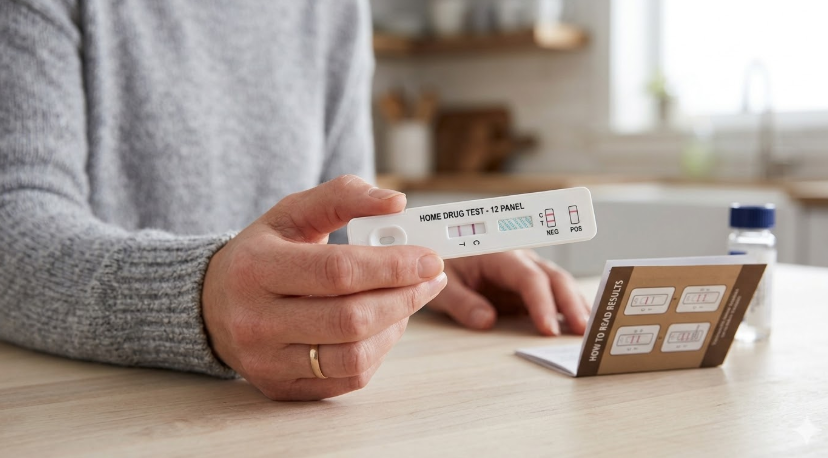
Taking an at-home drug test can feel nerve-wracking, whether you’re preparing for a new job, checking in on a loved one, or simply want peace of mind.
The good news? The process is simpler than most people expect, and understanding your results is straightforward once you know what to look for.
This guide walks you through everything: how accurate at-home tests really are, how to read the result lines correctly, and exactly what to do next depending on your result.
Important disclaimer: At-home urine drug tests are screening tools only. They are not a medical diagnosis or a legally confirmed result. A positive screening result always requires follow-up confirmatory testing at a certified laboratory before any serious decisions are made.
Understanding At-Home Drug Screening Test Accuracy
How Accurate Are They?
Most FDA-cleared at-home urine drug tests are highly accurate when used correctly. Many manufacturers report accuracy rates between 95% and 99% when instructions are followed precisely.
That said, there is an important distinction to understand. At-home tests are screening tests—a quick, low-cost first step. A confirmatory test, run by a certified lab using a method called Gas Chromatography/Mass Spectrometry (GC/MS), is a far more precise follow-up. According to Drugs.com, confirmatory GC/MS testing “almost reduces the risk [of a false positive] to zero.”
Think of the at-home test as the first filter—and the lab test as the final word.
Factors That Affect Accuracy
Even a great test can give unreliable results if these factors aren’t considered:
- User error: Reading results outside the time window printed on the box (for example, checking at 10 minutes when the instructions say 5) can produce misleading lines.
- Test quality: Expired tests or kits stored in extreme heat or cold may not perform as intended. Always check the expiration date before using.
- Urine concentration: Drinking large amounts of water before testing can dilute the sample. A very diluted sample may lower the concentration of a drug below the test’s detection threshold, potentially producing a false negative.
False Positives vs. False Negatives
False positives happen when the test signals a drug is present—but it isn’t. This occurs because the test’s antibodies sometimes react with other substances that share a similar chemical structure to the drug being tested.
Common triggers for false positives include:
- Poppy seeds — These naturally contain trace amounts of morphine and codeine and can trigger a false positive for opiates. The FDA and federal workplace testing guidelines both flag this as a known issue.
- Decongestants — Pseudoephedrine and phenylephrine, found in many cold medicines, can produce false positive results for amphetamines.
- Ibuprofen and naproxen (NSAIDs) — These common pain relievers have been documented to cause false positive results for marijuana (cannabinoids) and barbiturates in some assays.
- Certain antidepressants — Medications like bupropion (Wellbutrin) and sertraline (Zoloft) have been associated with false positives for amphetamines and benzodiazepines, respectively.
According to a review published in US Pharmacist, “immunoassays have poor specificity that may lead to false-positive results,” which is precisely why confirmatory testing exists.
False negatives occur when a drug is present but the test doesn’t catch it. This can happen if:
- Testing occurs too soon after drug use, before metabolites build up in the urine.
- Testing occurs after the detection window has passed. Many drugs are only detectable for 1–4 days after use, though chronic, heavy marijuana use can remain detectable for several weeks, according to clinical pharmacist guidance published in US Pharmacist.
- The urine sample is too diluted to reach the test’s cutoff threshold.
Step-by-Step: How to Read an At-Home Drug Screening Test
Preparation
Before you open the kit, read the instruction leaflet completely. Collect the urine sample in a clean, dry container, and set a timer the moment you dip or apply the test strip. Timing matters.
Reading results outside the stated window can make valid negative lines disappear—or make evaporation lines appear that look like results.
Decoding the Lines: The Golden Rule
Every urine drug test strip has two labeled regions:
- C — The Control line. This confirms the test worked correctly. It should always appear.
- T — The Test line. This is where the drug result is shown.
Here’s the part that surprises almost everyone: unlike a pregnancy test, two lines on a drug screen means NEGATIVE.
The Negative Result (Pass)
- What you see: Two colored lines—one in the C region and one in the T region.
- What it means: The drug being tested was not detected at or above the cutoff level in the sample. According to HomeHealthTesting.com, “any line, no matter how light or dark, in the ‘T’ area of a drug test indicates a negative drug screen result.”
The Positive Result (Fail)
- What you see: Only ONE colored line, appearing in the C (Control) region. No line appears in the T (Test) region.
- What it means: The drug or its metabolites were detected at a concentration above the test’s cutoff level. This is considered a preliminary positive, and confirmatory lab testing is the required next step.
The Invalid Result
- What you see: No line in the C (Control) region at all, regardless of whether a T line appears.
- What it means: The test did not work correctly. This could be due to insufficient urine volume, improper procedure, or a faulty test strip. Discard the test and repeat with a fresh one.
The “Faint Line” Dilemma: What Does It Mean?
This is, without a doubt, the question we hear most often. You see a very faint line in the T region and start to worry—does it mean something was detected?
The answer is clear: a line is a line. Even if the T line is barely visible, it is still counted as a Negative result.
Line intensity reflects the concentration of testing dye in the reaction, not the amount of any drug in the sample. HomeHealthTesting.com confirms this directly: “The intensity of the color of a line on the drug test should not be interpreted as a measure of the amount of drugs present.”
A faint T line does not mean you “barely passed.” It simply means the test did not detect the drug above the threshold.
What to Do After Your At-Home Test
If your result is negative: In most situations, you’re in the clear. A negative result means the test did not detect the substance being tested at a level above the cutoff. If you’re preparing for a formal employer drug screen, a negative home result is a reassuring sign—though official workplace tests are conducted by certified labs under monitored conditions.
If your result is positive: Don’t panic. Remember—this is a preliminary positive, not a confirmed result. Your very next step should be confirmatory lab testing.
Many at-home drug test kits include a prepaid envelope so you can send the urine sample directly to a laboratory. If your kit does not include this option, a certified drug testing facility or your healthcare provider can arrange a GC/MS confirmatory test.
As MedlinePlus, a resource from the US National Library of Medicine, explains: “The follow-up drug test after a false positive result is called a confirmatory test. It is a more sensitive test that provides more accurate results.”
Before any lab test—at-home or otherwise—inform the testing professional of any prescription medications, OTC medicines, supplements, or foods (like poppy seeds) you’ve consumed recently. This information protects you from a misinterpreted result.
Frequently Asked Questions
Can secondhand smoke cause a positive result?
This is a common concern, but the answer is almost certainly no. According to Drugs.com, “cut-off concentrations for lab analysis (usually 50 ng/mL) are set well above that which might occur from passive inhalation.” Simply being in a room where marijuana was smoked is extremely unlikely to push your result above the detection threshold.
How long do drugs stay in your system for a urine test?
Detection times vary significantly depending on the drug, how often it was used, your body’s metabolism, and urine pH. As a general guide:
- Most drugs: detectable for 1–4 days after use.
- Chronic, heavy marijuana use: potentially detectable for several weeks.
- Alcohol: typically clears within 24 hours.
These are estimates, not guarantees. Individual variation is significant.
Does a faint line mean I barely passed?
No. As explained above, a faint T line is still a negative result. The shade of the line has no bearing on drug concentration in the sample. Any visible line in the T region—no matter how light—means the test did not detect the drug above the cutoff.
Your Results Are a Starting Point, Not a Final Answer
At-home drug screening test accuracy is high when you use a quality, FDA-cleared kit and follow the instructions carefully. The key takeaway is simple: two lines mean negative, one line means a preliminary positive, and a faint line is still a pass.
But at-home tests are step one in a process—not the final word. If your result is positive, or if you have any doubt about accuracy, confirmatory GC/MS lab testing is the only way to get a result that holds up medically or legally.
For official or high-stakes results, always work with a certified testing facility or consult a healthcare professional. Your health decisions deserve the most accurate information available.