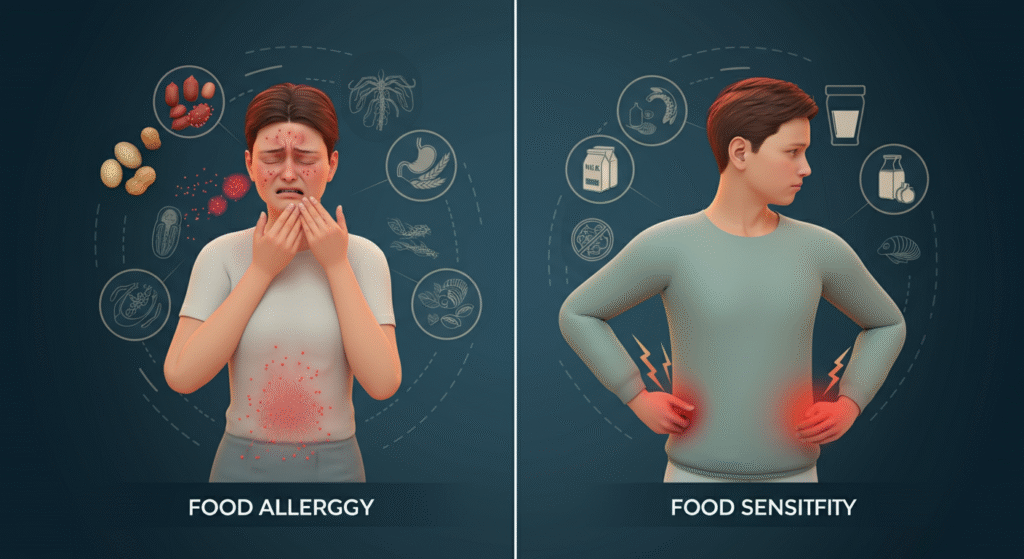
You’ve just finished a meal, and something feels off. Maybe your stomach is churning, you feel bloated, or perhaps a strange itch is developing on your skin. You suspect it was something you ate, but what does it mean? Is it a food allergy or something else?
Many people use the terms “food allergy” and “food sensitivity” interchangeably, but they describe very different reactions within your body. This confusion can lead to misdiagnosis and improper management, preventing you from feeling your best. Understanding the distinction is the first step toward identifying the root cause of your discomfort and finding a solution.
This post will clearly explain the difference between a food allergy and a food sensitivity. We will explore the science behind each reaction, how to recognize the distinct symptoms, what proper allergy testing involves, and when it’s crucial to see a doctor. By the end, you’ll be better equipped to interpret your body’s signals and take control of your diet.
What is a Food Allergy?
A food allergy is a serious immune system reaction. It occurs when your body mistakenly identifies a specific protein in a food as a dangerous invader, like a virus or bacteria. In response, your immune system goes into defense mode.
To fight off this perceived threat, your body releases chemicals, most notably histamine. This chemical flood triggers immediate and sometimes severe allergy symptoms that can affect multiple parts of the body, including the skin, respiratory system, and cardiovascular system. Because this is an immune-driven response, even a microscopic amount of the allergenic food can set off a major reaction.
Common food allergens that account for about 90% of all food allergies include:
- Peanuts
- Tree nuts (like almonds, walnuts, and cashews)
- Milk
- Eggs
- Soy
- Wheat
- Fish
- Shellfish (like shrimp, crab, and lobster)
Typical allergy symptoms can range from mild to life-threatening. They often appear within minutes to a couple of hours after ingestion and may include hives, itchy rashes, swelling of the lips, tongue, or throat, difficulty breathing, wheezing, vomiting, and a sudden drop in blood pressure. In the most severe cases, a food allergy can lead to anaphylaxis, a life-threatening reaction that requires immediate medical attention.
Sarah’s Story: Sarah, who has a severe peanut allergy, takes a bite of a cookie at a party, unaware that it contains peanut fragments. Within minutes, her lips begin to swell, she develops hives on her arms, and she starts wheezing. Recognizing the signs of anaphylaxis, she immediately uses her epinephrine auto-injector (EpiPen) and calls 911. Her quick action is critical in managing this severe allergic reaction.
What is a Food Sensitivity?
A food sensitivity, also known as a food intolerance, is primarily a digestive system issue. Unlike an allergy, it does not involve an immune system response. Instead, it occurs when your body has difficulty breaking down and digesting a particular food or ingredient.
The mechanism behind a food sensitivity is often a lack of a specific enzyme needed for digestion. The most well-known example is lactose intolerance, where the body doesn’t produce enough lactase to break down lactose, the sugar in milk. Sensitivities can also be triggered by reactions to certain food additives, such as MSG or sulfites, or natural compounds in food like gluten.
Common culprits for food sensitivities include:
- Lactose (in dairy products)
- Gluten (in wheat, barley, and rye)
- Food additives (MSG, sulfites, artificial colors)
- Caffeine
The symptoms of food sensitivity are generally less severe than allergy symptoms and are not life-threatening. They are typically confined to the digestive tract and can include gas, bloating, stomach cramps, diarrhea, and constipation. A key difference is that these symptoms are often delayed, appearing several hours after eating the offending food.
Furthermore, the reaction is often dose-dependent, meaning a small amount of the food might cause no issues, while a larger portion could lead to significant discomfort.
Key Differences at a Glance
To make it easier, here’s a quick comparison of the two conditions:
| Feature | Food Allergy | Food Sensitivity |
|---|---|---|
| System Involved | Immune System | Digestive System |
| Reaction Time | Immediate (minutes to 2 hours) | Delayed (up to 72 hours) |
| Symptoms | Hives, swelling, difficulty breathing, anaphylaxis | Gas, bloating, stomach pain, diarrhea |
| Severity | Potentially life-threatening | Uncomfortable but not life-threatening |
| Amount Needed | A tiny trace can trigger a reaction | Varies (often dose-dependent) |
How Are They Diagnosed?
Getting the right diagnosis is crucial for proper management. The methods for identifying allergies and sensitivities are very different.
Allergy Testing
Because food allergies involve an immune response, they can be diagnosed with clinically validated medical tests. A board-certified allergist will typically use one of the following methods:
- Skin Prick Test: A tiny amount of the suspected allergen is placed on the skin, which is then pricked. If a raised, red bump (a wheal) forms, it indicates a possible allergy.
- Blood Test: A blood sample is taken to measure the amount of specific Immunoglobulin E (IgE) antibodies to a certain food. High levels of IgE can signal an allergy.
- Oral Food Challenge: Considered the gold standard for diagnosis, this test is done under strict medical supervision. The patient eats small, increasing amounts of a food to see if a reaction occurs.
Identifying Food Sensitivity
Pinpointing a food sensitivity is less straightforward, as there are no reliable clinical tests for it. Many commercial food sensitivity tests you see online are not backed by scientific evidence. The most effective methods involve careful observation and dietary tracking:
- Elimination Diet: This is the most reliable approach. You systematically remove a suspected food from your diet for a few weeks to see if your symptoms improve. Then, you reintroduce the food to see if the symptoms return. This should ideally be done under the guidance of a doctor or registered dietitian.
- Food and Symptom Diary: Keeping a detailed log of everything you eat and any symptoms you experience can help you and your healthcare provider identify patterns over time. Note the time you ate and when symptoms appeared.
Managing Your Diet and When to See a Doctor
Your management strategy will depend entirely on whether you have an allergy or a sensitivity.
For a food allergy, strict avoidance of the allergen is essential. This involves reading food labels carefully, being cautious when dining out, and preventing cross-contamination in the kitchen. If you are prescribed an epinephrine auto-injector, you must carry it with you at all times.
For a food sensitivity, management is often more flexible. You may only need to limit the amount of the problem food you consume. In some cases, like with lactose intolerance, you can use enzyme supplements (e.g., lactase pills) to help your body digest the food.
It’s important to know when to seek medical help. If you experience any signs of a severe allergic reaction, such as difficulty breathing, swelling of the throat, or feeling faint, call 911 and seek emergency medical care immediately. For persistent digestive issues that impact your quality of life, schedule an appointment with a doctor to investigate the cause.
Take Control of Your Plate
Understanding the difference between a food allergy and a food sensitivity is the first step toward managing your health effectively. Allergies are serious, immune-mediated reactions that require strict avoidance, while sensitivities are digestive issues that cause discomfort but are not life-threatening. Self-diagnosis can be misleading and risky, so getting a proper diagnosis is key.
If you consistently feel unwell after eating certain foods, don’t ignore your body’s signals. Consult a healthcare professional or a registered dietitian. They can help you get the right diagnosis through proper allergy testing or a guided elimination diet and create a management plan that works for you, allowing you to eat with confidence and feel your best.