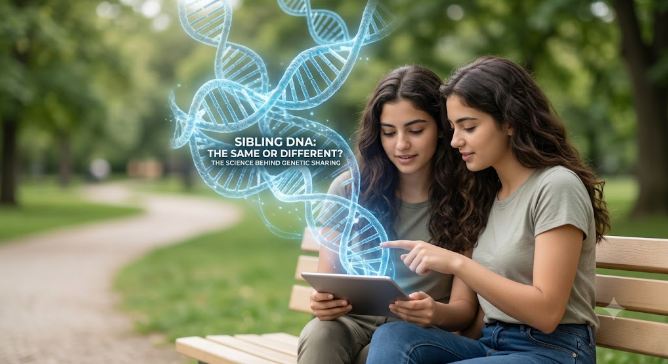
Quick answer: No, full siblings do not have the same DNA—unless they are identical twins. On average, full biological siblings share about 50% of their DNA. They inherit from the same two parents, but the specific combination of genes each child receives is entirely unique, making every sibling genetically one-of-a-kind.
You and your sibling grew up in the same house, ate the same food, and share the same parents. So why does your brother have curly hair while yours is stick-straight? Or why does your sister’s ancestry test show more Irish heritage than yours?
The answer comes down to how DNA is inherited—and the surprising amount of randomness baked into the process.
Genetics can sound intimidating, but the core ideas are actually pretty simple. This article breaks down exactly how sibling DNA works, why siblings can look so different (or so similar), and what a DNA test can tell you about your relationship with a brother or sister.
No science degree required.
The Quick Answer: Do Siblings Have the Same DNA?
No—full siblings do not share identical DNA.
On average, two full biological siblings share about 50% of their DNA. That sounds like a lot, and it is. But that other 50%? It differs between them, which is what makes each person genetically unique.
The only exception is identical twins. They come from a single fertilized egg that splits in two, so they share essentially 100% of their DNA.
Everyone else—full siblings, fraternal twins, half-siblings—gets a unique genetic hand dealt to them at conception. Same parents, different combinations.
The Science of Sibling DNA: Why Aren’t We Carbon Copies?
How do we inherit DNA from our parents?
Every human cell contains 46 chromosomes, arranged in 23 pairs. When you were conceived, you received 23 chromosomes from your mother and 23 from your father. Together, they formed your unique set of 46.
Your sibling went through the exact same process. Same parents, same basic setup. But here’s the thing—the specific chromosomes each of you received were not the same.
Think of it like drawing cards from two decks. Your parents each have two copies of every chromosome. When they create eggs or sperm, only one copy gets passed on. Which one? That’s essentially random.
What is genetic recombination, and how does it increase variation?
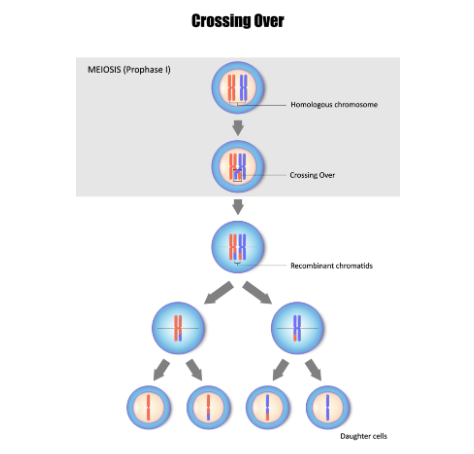
It gets even more interesting. Before chromosomes are passed on, something called genetic recombination (also called “crossover”) happens.
During the formation of eggs and sperm, pairs of chromosomes physically swap segments of DNA with each other. Imagine cutting two decks of cards mid-shuffle and mixing the halves together. The result is a brand-new chromosome that’s never existed before—a mashup of both originals.
This process means that no two eggs or sperm are genetically identical, even from the same person. Every time your parents conceived a child, a completely new genetic combination was created.
That’s why siblings can be so similar—yet so different.
Exactly How Much DNA Do Different Types of Siblings Share?
Genetics isn’t one-size-fits-all. The amount of DNA shared depends entirely on the type of sibling relationship.
| Sibling Relationship | Average DNA Shared | Range of DNA Shared |
|---|---|---|
| Identical Twins | 100% | ~100% |
| Fraternal Twins | 50% | 38% – 61% |
| Full Siblings | 50% | 38% – 61% |
| Half-Siblings | 25% | 17% – 34% |
A few things worth noticing here:
Fraternal twins and full siblings are genetically equivalent. Fraternal twins don’t share any more DNA than regular siblings born years apart. The only difference is timing—they happened to develop in the womb at the same time.
The range for full siblings is surprisingly wide. Two full siblings could share anywhere from 38% to 61% of their DNA. That’s a big window, and it explains a lot about why some sibling pairs look nearly identical while others barely resemble each other.
Half-siblings share roughly half as much DNA as full siblings, which reflects having only one biological parent in common instead of two.
Why Do Some Siblings Look Exactly Alike—and Others Don’t?
This is where it gets really interesting for everyday life.
What is the difference between genotype and phenotype?
Your genotype is your actual DNA—the code written in your cells. Your phenotype is how that code physically shows up: your height, eye color, hair texture, skin tone, and so on.
Two siblings can have different genotypes but end up with similar phenotypes. Or they can have surprisingly different phenotypes despite sharing 50% of their DNA. It all depends on which genes each sibling inherited—and how those genes interact.
How do dominant and recessive genes affect sibling appearance?
Most traits are influenced by multiple genes, but the classic example of eye color helps illustrate the point.
Brown eyes are generally dominant. Blue eyes are generally recessive.
If both parents carry a recessive blue-eye gene, there’s a chance one sibling inherits two copies of the blue-eye gene and ends up with blue eyes—while their brother inherits the dominant brown version and has brown eyes. Same parents, completely different outcome.
The same logic applies to things like freckles, dimples, hair curl, and dozens of other visible traits. It’s not random in the sense that anything could happen—but the combination of which genes get expressed is different for every child.
Can a Sibling DNA Test Prove Full vs. Half-Siblings?
Yes, and modern DNA tests are quite good at this.
How do DNA tests measure sibling relationships using centimorgans?
DNA testing services like AncestryDNA and 23andMe measure genetic relationships using a unit called a centimorgan (cM). Centimorgans measure how much shared DNA appears in the same location across two people’s genomes—essentially, how genetically linked two people are.
Here’s how the numbers typically break down:
- Full siblings: 2,200–3,300 cM shared
- Half-siblings: 1,300–2,300 cM shared
Because the ranges for full siblings and half-siblings are quite distinct, a DNA test can usually determine the relationship accurately. There’s some overlap at the edges, which is why results are sometimes described as “likely full sibling” or “probable half-sibling,” but in most cases the distinction is clear.
This kind of testing has become a popular way to confirm biological relationships—especially for people who were adopted, or who have questions about their family history.
Frequently Asked Questions
Can full siblings share less than 50% DNA?
Yes. Because the shuffling of genetic material during conception is random, the exact percentage varies. Full siblings typically share between 38% and 61% of their DNA. Sharing slightly less than 50% is entirely possible—it doesn’t mean the relationship isn’t genuine, just that the genetic lottery landed that way.
Do fraternal twins share more DNA than regular siblings?
No. Fraternal twins share the same average amount of DNA as any other full siblings—about 50%. They developed at the same time, but they came from two separate eggs fertilized by two separate sperm. Genetically, they are no more similar than siblings born years apart.
Why does my DNA test show different ancestry percentages than my sibling?
Because you each inherited a different mix of DNA segments from your parents. If your father is 50% Irish and 50% Italian, you might have inherited more of his Irish-linked segments, while your sibling inherited more of the Italian-linked ones. Neither result is wrong—they just reflect the randomness of what each of you received.
Are half-siblings considered “real” siblings by DNA testing companies?
DNA testing companies like AncestryDNA and 23andMe typically categorize half-siblings under “close family” or “half-sibling” matches based on the centimorgan count. They are real biological relatives—they simply share one biological parent rather than two, which is reflected in the lower amount of shared DNA (around 25% on average).
Does sharing 50% DNA mean siblings are genetically “half” the same person?
Not exactly. Sharing 50% DNA means that half of your genetic variants—called alleles—are the same. But genes interact in complex ways, so two people sharing 50% of their DNA can look and behave very differently. DNA is more like a recipe than a blueprint—the same ingredients can produce surprisingly different results depending on how they combine.
Embracing Our Genetic Uniqueness
Here’s the takeaway: siblings share a deep genetic connection, but nature’s built-in randomness ensures that every person (outside of identical twins) ends up with a one-of-a-kind genome.
You and your sibling come from the same genetic starting point. But through recombination, random chromosome selection, and the complex interplay of dominant and recessive traits, each of you ended up with a completely unique combination.
That’s not a flaw in the system. That’s the system working exactly as designed.
The next time someone says you look nothing like your brother, or asks why your ancestry results differ from your sister’s—you’ll know exactly why. And honestly? The fact that the same two people could produce so many genetically distinct individuals is one of the more remarkable things about human biology.
Meta data
Meta title
Will Siblings Have the Same DNA? The Truth Explained
Meta description
Full siblings share about 50% of their DNA—but not the same DNA. Learn why siblings look different, how DNA testing works, and what the science really says.