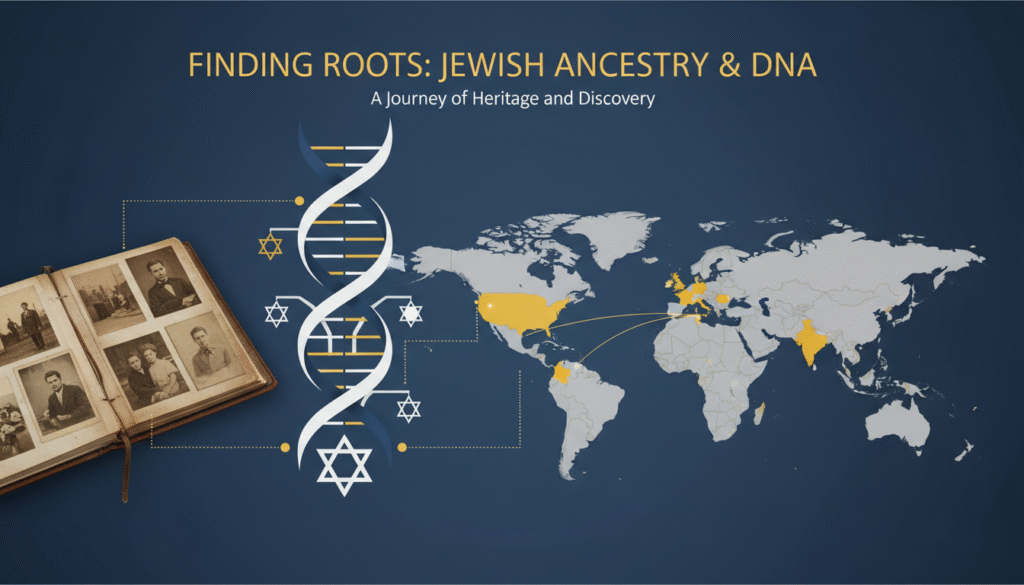
For centuries, Jewish history has been defined by migration, diaspora, and community. Because families were often scattered across continents due to persecution or economic necessity, oral histories can sometimes become fragmented or lost entirely. For many, the desire to reconnect with these lost branches and confirm family lore is powerful.
Fortunately, modern science has provided a bridge to the past. DNA testing has revolutionized genealogy, offering a way to uncover ethnic origins and connect with distant relatives. However, due to the unique genetic history of Jewish populations—specifically the practice of endogamy (marrying within the community)—not all DNA tests provide the same level of clarity.
Choosing the right service can be the difference between a vague regional estimate and a specific connection to a shtetl in Eastern Europe or a community in North Africa. This guide explores the best DNA tests for Jewish ancestry, helping you choose the tool that best fits your journey of discovery.
Overview of DNA Testing
Before purchasing a kit, it is helpful to understand the science behind it. Most commercial services offer three main types of testing, though only one is primarily used for ethnicity estimates.
Autosomal DNA
This is the standard test offered by companies like AncestryDNA, 23andMe, and MyHeritage. It looks at the DNA inherited from both parents (roughly 50% from each) and can identify relatives on both sides of your family tree, back about five to seven generations. This is the most effective method for determining Jewish ethnicity percentages, such as Ashkenazi, Sephardic, or Mizrahi.
Y-DNA
This test analyzes the Y chromosome, which is passed down exclusively from father to son. It explores direct paternal lineage deep into the past. While less useful for recent family matching, it can be fascinating for tracing ancient migration patterns of Jewish distinct lineages, such as the Kohanim (priestly) line.
mtDNA (Mitochondrial DNA)
This test looks at the mitochondria passed from mothers to their children. It traces the direct maternal line. Like Y-DNA, it is more about deep ancestry and migration routes than finding a second cousin in New York.
Factors to Consider When Choosing a Test
Not all algorithms are created equal. When specifically looking for Jewish heritage, keep these three factors in mind:
- Reference Populations: To accurately identify Jewish DNA, the company needs a robust reference panel. Ashkenazi Jewish DNA is distinct and easier for most companies to identify. However, Sephardic and Mizrahi DNA can be harder to distinguish from general Southern European, North African, or Middle Eastern genetics without a specialized database.
- Database Size: If your goal is to find living relatives, size matters. The larger the database, the higher the probability of finding a match.
- Privacy Policies: DNA data is sensitive. Always review how a company stores your data, who they share it with, and whether you can delete it later.
Top DNA Tests for Jewish Ancestry
While many companies offer testing, three stand out for their accuracy and features regarding Jewish genealogy.
AncestryDNA
AncestryDNA boasts the largest consumer DNA database in the world, with over 25 million people. For Jewish users, specifically those of Ashkenazi descent, this is a massive advantage. The sheer volume of users increases the likelihood of finding relatives to build out your family tree.
AncestryDNA is highly accurate in identifying Ashkenazi heritage. They have also improved their “Genetic Communities” feature, which can sometimes pinpoint specific regions of settlement in Eastern Europe. If your primary goal is genealogy—building a tree and finding cousins—this is often the top choice.
MyHeritage DNA
While AncestryDNA is the giant, MyHeritage is often considered the specialist for Jewish genealogy. Based in Israel, MyHeritage has a disproportionately large user base in Europe and Israel compared to its competitors.
This is the preferred test if you are looking for relatives who remained in Europe or moved to Israel, rather than those who migrated to the United States. Furthermore, MyHeritage has made significant strides in breaking down Jewish ethnicities beyond just “Ashkenazi,” offering genetic groups that help identify Sephardic and Mizrahi roots with greater nuance than many competitors.
23andMe
23andMe is widely recognized for its scientific rigor and excellent user interface. While its database is smaller than Ancestry’s, it offers a distinct advantage: health screening.
Due to historical endogamy, Ashkenazi Jewish populations are at higher risk for certain genetic conditions, such as Tay-Sachs disease and specific BRCA mutations linked to breast and ovarian cancer. 23andMe offers an FDA-authorized report on selected BRCA variants (though this should never replace medical testing by a doctor).
On the ancestry front, 23andMe provides a detailed “Ancestry Composition” that is often praised for its accuracy in distinguishing between broadly European DNA and distinct Jewish markers.
Comparing the Tests
| Feature | AncestryDNA | MyHeritage | 23andMe |
|---|---|---|---|
| Best For | Building Family Trees & Finding Relatives | European/Israeli Matches & Sephardic Roots | Health Insights & Ethnicity breakdown |
| Database Size | Largest (~25M+) | Medium (Strong in EU/Israel) | Large (~14M+) |
| Ashkenazi Accuracy | Excellent | Excellent | Excellent |
| Sephardic/Mizrahi | Good | Very Good | Good |
| Genealogy Tools | Extensive | Extensive | Limited |
Understanding Jewish Genetic History
Interpreting your results requires a basic understanding of Jewish history. Jewish communities are often defined by endogamy, meaning that for centuries, Jews married other Jews.
This creates a genetic distinctiveness that makes Ashkenazi DNA, in particular, very easy to identify. In fact, Ashkenazi Jews are genetically more similar to each other than most other ethnic populations. This can complicate genealogy, as you might share a significant amount of DNA with someone who is only a distant cousin, simply because you share multiple common ancestors from centuries ago.
It is also important to note the major subgroups:
- Ashkenazi: Originating from Central and Eastern Europe (Germany, Poland, Russia). Most DNA tests identify this group with high precision.
- Sephardic: Descendants of Jews expelled from Spain and Portugal in 1492, who settled in North Africa, the Ottoman Empire, and the Netherlands. This DNA often appears as a mix of Jewish, Southern European, and North African markers.
- Mizrahi: Jews who remained in the Middle East (Iraq, Iran, Yemen). These markers often overlap with general Middle Eastern populations, making MyHeritage or 23andMe better options for parsing these nuances.
Tips for Interpreting Results
When you receive your email notification that your results are ready, keep these tips in mind:
- Look at the “Confidence” Range: Most ethnicity estimates are just that—estimates. Look at the range provided. A result might say “15%,” but the range might be “0%–20%.”
- Upload to GEDmatch: Once you have your raw data from any of the major providers, you can upload it to GEDmatch. This is a third-party tool that offers different algorithms (calculators) that can sometimes provide a different perspective on your heritage.
- Don’t ignore “Trace” Regions: Small percentages of unexpected regions (like Italian or Middle Eastern for Ashkenazi Jews) can often be echoes of ancient migration paths from the Levant to Europe.
Ethical and Privacy Considerations
Before spitting in the tube, consider the implications. When you test, you aren’t just exposing your own genetic data, but that of your siblings, parents, and children.
Anonymity is difficult to guarantee in the age of big data. While companies like Ancestry and 23andMe resist law enforcement requests without a valid warrant, other databases allow law enforcement to use genetic profiles to solve cold cases.
Additionally, you should prepare yourself for the possibility of uncovering family secrets, such as non-paternity events (where a father is not the biological parent) or unknown half-siblings.
Which Test Should You Buy?
The “best” DNA test for Jewish ancestry depends entirely on what you hope to discover.
If you want to build a comprehensive family tree and find cousins in the United States, AncestryDNA is the clear winner due to its database size. If you are looking for relatives in Israel or Europe, or if you have Sephardic or Mizrahi heritage, MyHeritage is likely your best bet. Finally, if you are interested in the intersection of your heritage and your health, 23andMe offers insights that others cannot match.
If you’ve narrowed your choice down to these two but need help deciding based on features, tools, and value, our MyHeritage vs. 23andMe breakdown is the perfect next step.
Whichever route you choose, you are taking a meaningful step toward preserving a history that has survived against the odds.
DISCLAIMER:
This content is for informational purposes only and is not intended as medical advice. Always consult a healthcare professional before making health decisions.